



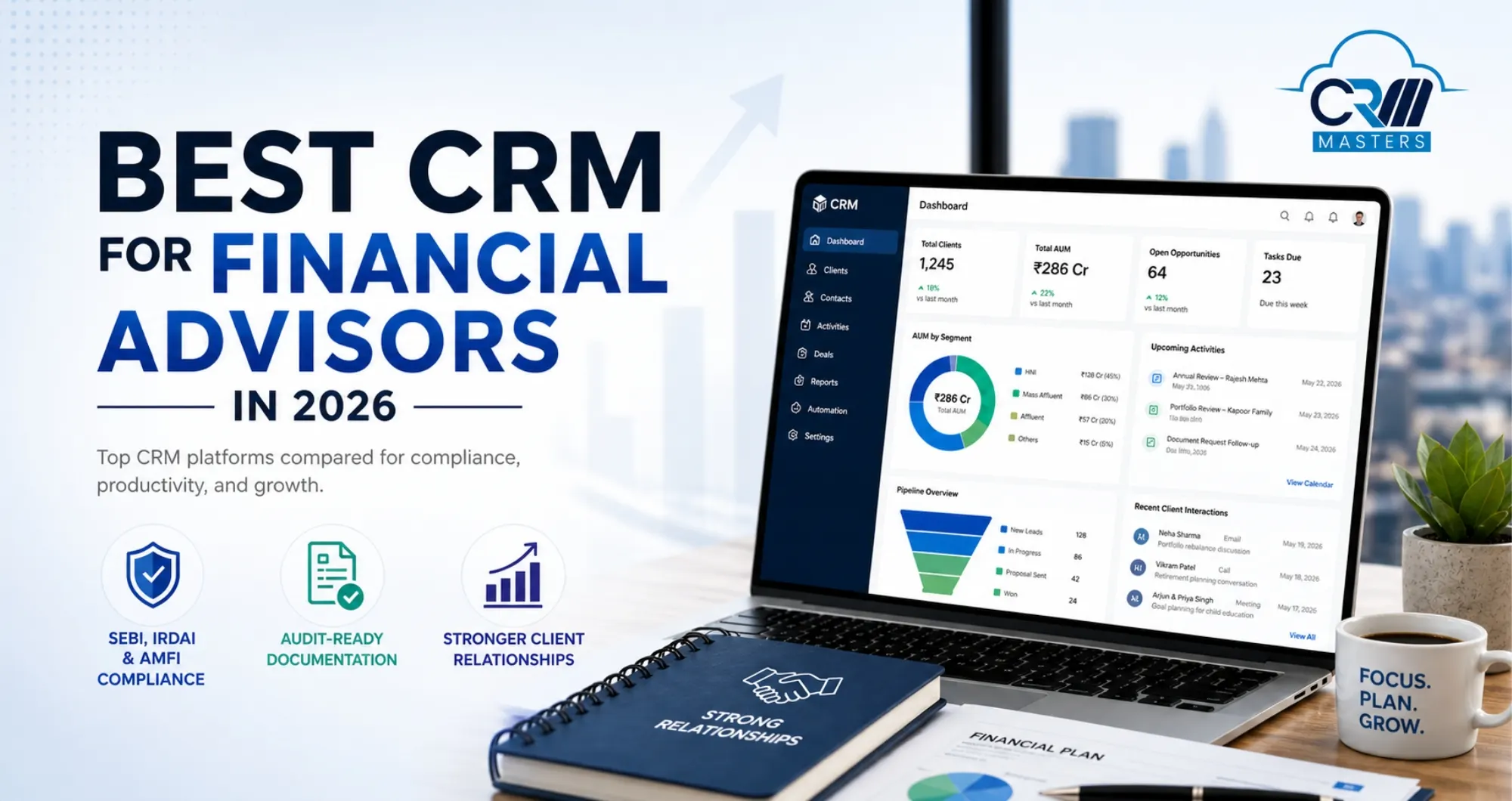
Best CRM for Financial Advisors in 2026
Financial advisory work depends on precision, consistency, and timely communication. As client portfolios grow, managing relationships through spreadsheets or disconnected tools becomes difficult to sustain, especially when compliance, follow-ups, and documentation all need to stay aligned. This is where CRM for financial advisors becomes essential. The global CRM market is projected to exceed $157 billion by 2030, growing at a CAGR of over 13%, and financial services is one of the fastest-growing verticals driving that expansion.
However, not every CRM is designed with financial advisory needs in mind. Some focus on marketing, others on enterprise sales, while only a few offer the flexibility and compliance depth required in wealth management practices. In this blog, we compare the best CRM software for financial advisors in 2026, covering leading platforms used by advisory firms of different sizes.
Why Financial Advisors Need a Dedicated CRM?
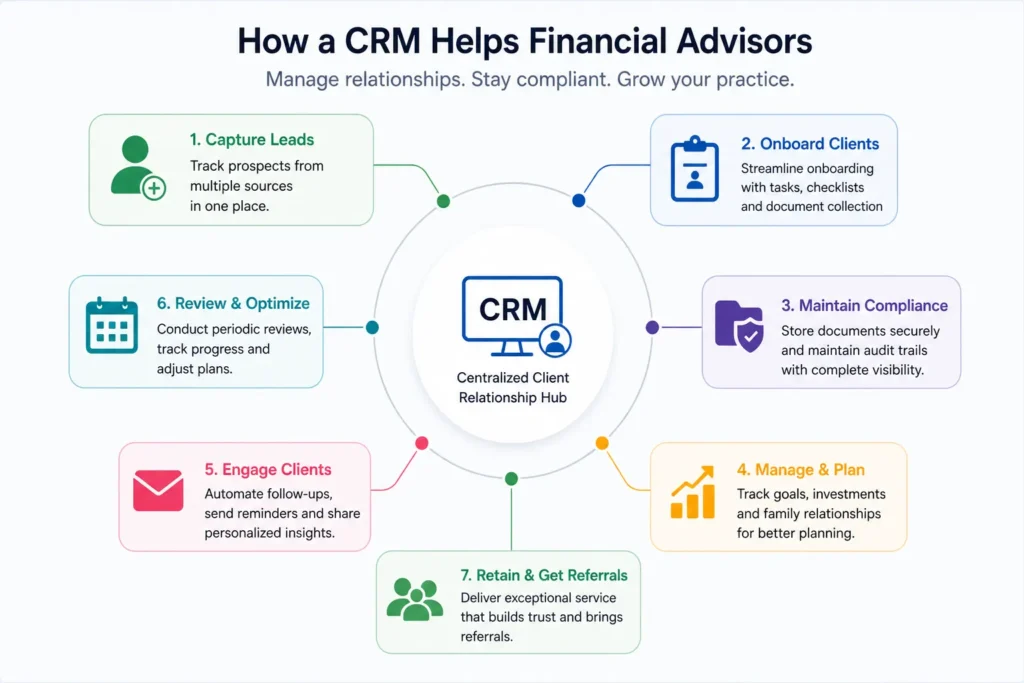
Financial advisory is a relationship-driven business. Your clients trust you with their savings, their retirement, and their children’s futures. That level of trust demands consistent, personalized, and well-documented communication, which is nearly impossible to deliver manually as your client base grows.
A purpose-fit CRM for financial advisor practices helps you:
- Maintain a complete, organized history of every client interaction
- Automate routine tasks like follow-up emails, review reminders, and document requests.
- Stay compliant with regulatory documentation requirements.
- Segment clients by AUM, life stage, or financial goal for targeted outreach.
- Manage your sales pipeline and track new prospects efficiently.
- Collaborate across your team without losing context or dropping the ball.
Without the right CRM, even the most talented advisors find themselves overwhelmed, reactive instead of proactive, and unable to scale without sacrificing service quality.
5 Signs Your Practice Has Outgrown Spreadsheets
Not sure if you’re ready for a CRM? If any of these sound familiar, you are:
1. Follow-Ups Getting Missed:
A prospect showed interest last week, and nobody followed up because it got buried in someone’s inbox. This is the single most common revenue leak that a CRM closes immediately.
2. No Single View of Client Data:
Contact details in Gmail, notes in a Word file, policy info in a spreadsheet. When there’s no single source of truth, your team is always working with an incomplete picture.
3. Onboarding Varies Every Time:
Every new client goes through a slightly different process depending on who handles them. That’s a service quality problem, and a compliance risk.
4. Hard to Pull the Right Client List:
If pulling a list of all clients above a certain AUM bracket or approaching retirement takes more than a few clicks, your data isn’t working for you.
5. Documents Not Audit-Ready:
Audit time shouldn’t feel like a fire drill. If signed agreements, interaction logs, and KYC documents aren’t centralized and retrievable, you’re carrying unnecessary regulatory risk every single day.
What to Look for in the Best CRM Software for Financial Advisors
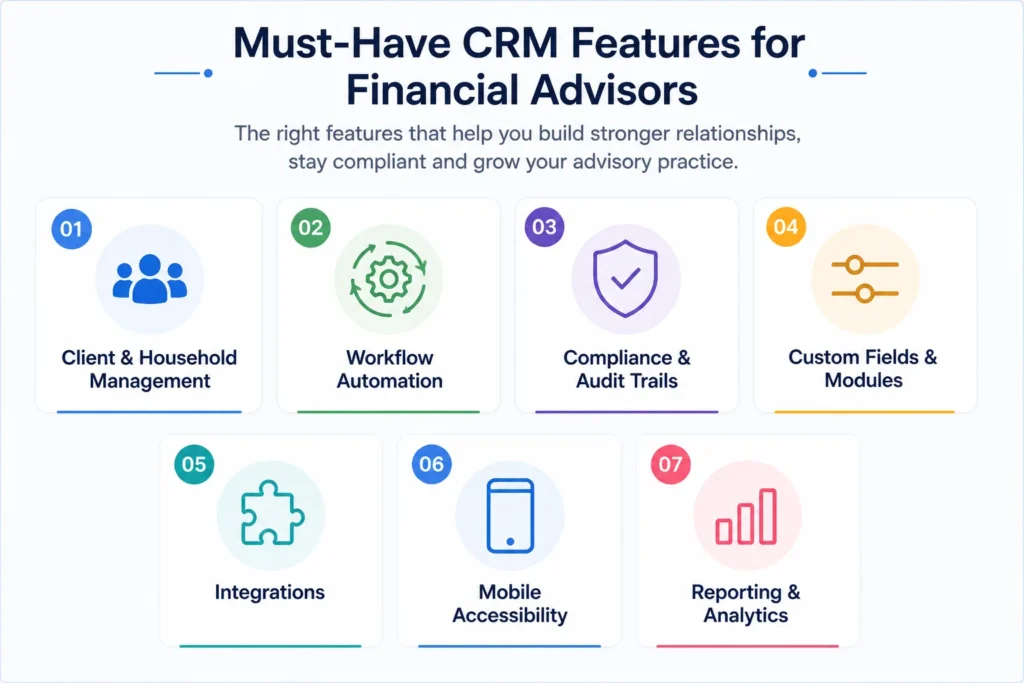
Not every CRM is designed with the unique needs of financial services in mind. Before evaluating your options, here are the non-negotiable features to prioritize:
1. Client and Household Management
Financial advisors often serve entire families, not just individuals. Your CRM should support household linking, connecting spouses, dependents, and related accounts under one unified view, so you always have full context before a meeting or call.
2. Workflow Automation
The best CRM software for financial advisors automates repetitive, time-sensitive tasks: scheduling annual review reminders, triggering onboarding sequences, sending birthday or milestone messages, and escalating overdue follow-ups. Automation is what separates advisors who are reactive from those who are always one step ahead.
3. Compliance and Audit Trails
Operating under regulatory frameworks means every client interaction needs to be documented and retrievable. Look for a CRM that logs all communications, stores documents securely, and produces audit-ready records on demand.
4. Custom Fields and Modules
Your practice is unique. A CRM that allows full customization, custom fields for risk profiles, investment goals, or policy renewal dates, ensures the software adapts to your workflow, not the other way around.
5. Integration with Your Existing Tools
Whether you use Gmail, Outlook, financial planning software, or digital signature tools, your CRM should plug into your existing ecosystem without friction.
6. Mobile Accessibility
Client meetings happen in boardrooms, coffee shops, and over the phone. A strong mobile CRM experience means your client data is always within reach.
7. Reporting and Analytics
Understanding your practice’s health, client retention, AUM growth, pipeline conversion, and acquisition costs requires data. The right CRM software for financial advisors gives you dashboards and custom reports built around the metrics that matter to you, not just generic sales teams.
Top 5 Best CRM for Financial Advisors in 2026
1. Zoho CRM
Zoho CRM offers the most flexible and cost-effective solution for financial advisory practices of all sizes. Unlike advisor-specific CRMs that lock you into rigid templates, Zoho lets you build the system around how your practice actually works, with custom modules for KYC documentation, risk assessments, client portfolios, and policy renewals included.
As a Zoho Partner with hundreds of implementations across financial advisory firms, we have seen firsthand what Zoho CRM does for practices that set it up correctly. Admin time drops, client engagement improves, and processes that used to depend on individual memory become repeatable, documented, and scalable.
What makes it stand out:
- Blueprint enforces a consistent client journey from onboarding through annual reviews, with automated tasks and compliance checkpoints at every stage.
- Zia AI predicts which clients need attention, flags stale records, and suggests the best time to reach out, built in from the Standard plan, no extra subscription needed.
- Every interaction across email, call, WhatsApp, and SMS is automatically logged to the client’s profile.
- Native integrations with Zoho Sign, Zoho Books, Zoho Campaigns, and Zoho Analytics eliminate data silos across your entire practice.
- Role-based access controls, activity logs, and audit trails provide a solid compliance infrastructure for advisors operating under SEBI, IRDAI, or similar regulatory frameworks.
- Advisors using Zoho’s automation typically reclaim 5–8 hours per week on manual follow-ups and admin.
2. Wealthbox
Wealthbox is the fastest-growing CRM among independent advisors for a simple reason: it actually gets used. The modern, intuitive interface requires no formal training, and teams are typically operational within days, not weeks.
What makes it stand out:
- Purpose-built for advisors, household management, beneficiary tracking, and opportunity tracking are all native.
- AI Notetaker (launched 2025) handles meeting preparation, collaboration, and follow-ups automatically.
- Native custodian integrations with Schwab, Fidelity, Pershing, and 100+ wealthtech partners.
- Two-way email sync logs all client communications automatically to the contact record.
- Rated #1 CRM in wealthtech on G2, and free database migration is included when switching.
3. Salesforce Financial Services Cloud
Salesforce FSC is the most powerful CRM on this list, purpose-built for large wealth management firms that need unlimited customization, sophisticated compliance infrastructure, and enterprise-grade scalability.
What makes it stand out:
- Pre-built financial objects for households, accounts, goals, policies, and relationships, no custom builds needed from scratch.
- Einstein AI delivers client churn-risk scoring, next-best-action recommendations, and AUM-growth forecasting.
- Full SEC/FINRA compliance infrastructure, audit trails, role-based access, data archiving, and eDiscovery built in.
- 5,000+ AppExchange integrations covering virtually every custodian, planning tool, and portfolio platform.
- Native connections to all major custodians and financial planning systems.
4. Redtail CRM
Redtail is the most widely used advisor CRM in the market, trusted by over 100,000 financial professionals since 2003. Its unique database pricing model, not per user, makes it the most cost-effective option for established teams. A 15-advisor firm pays roughly $6.60 per advisor per month.
What makes it stand out:
- Unlimited users per database; the larger your team, the better the value.
- Redtail Speak provides compliant, archived text messaging that meets FINRA documentation requirements.
- Redtail Imaging handles secure, searchable document storage directly inside the CRM.
- 100+ native integrations with custodians, financial planning tools, and compliance platforms.
- Now part of Orion’s ecosystem, enabling deeper connections with Orion Planning, Portfolio View, and the Denali AI platform.
- Redtail University offers both remote and in-person training with consistently praised support.
5. HubSpot
HubSpot is not built for financial services, but for advisors who run significant marketing alongside their practice. Nothing on this list comes close to lead generation and prospect nurturing. The free CRM tier is genuinely functional, and the Marketing Hub is best-in-class.
What makes it stand out:
- Best-in-class email marketing, landing pages, and automated nurture sequences for client acquisition.
- Breeze AI helps with content creation, email drafting, and prospect research.
- Intuitive interface with minimal learning curve; most users reach full proficiency in under four hours.
- Excellent funnel analytics and reporting for practices tracking business development metrics.
- Free core CRM makes it the best starting point for solo advisors just getting organized.
| CRM | Best For | Basic Pricing | AI Features | Customization | Best for Team Size |
| Zoho CRM | Growing practices need flexibility | $14/user/mo | Zia AI (built-in, no extra cost) | Fully customizable | Any size |
| Wealthbox | Modern RIAs want fast adoption | $59/user/mo | AI Notetaker + AI Agents | Low | Small to mid |
| Salesforce Financial Services Cloud | Enterprise wealth management firms | $325/user/mo | Einstein AI | Very High | Large enterprise |
| Redtail CRM | Established teams needing compliance depth | ~$99/mo per database | Via Orion Denali | Moderate | Mid to large |
| HubSpot | Marketing-driven solo advisors | Free for up to 2 users | Breeze AI | Moderate | Solo to small |
Prices mentioned above are sourced from data available online and are subject to change. Please visit each platform’s official website or contact them directly for actual pricing.
Also Read: Top Zoho Integrations Every Business Should Use in 2026
Zoho CRM: The Best CRM for Financial Advisors Seeking Flexibility and Power
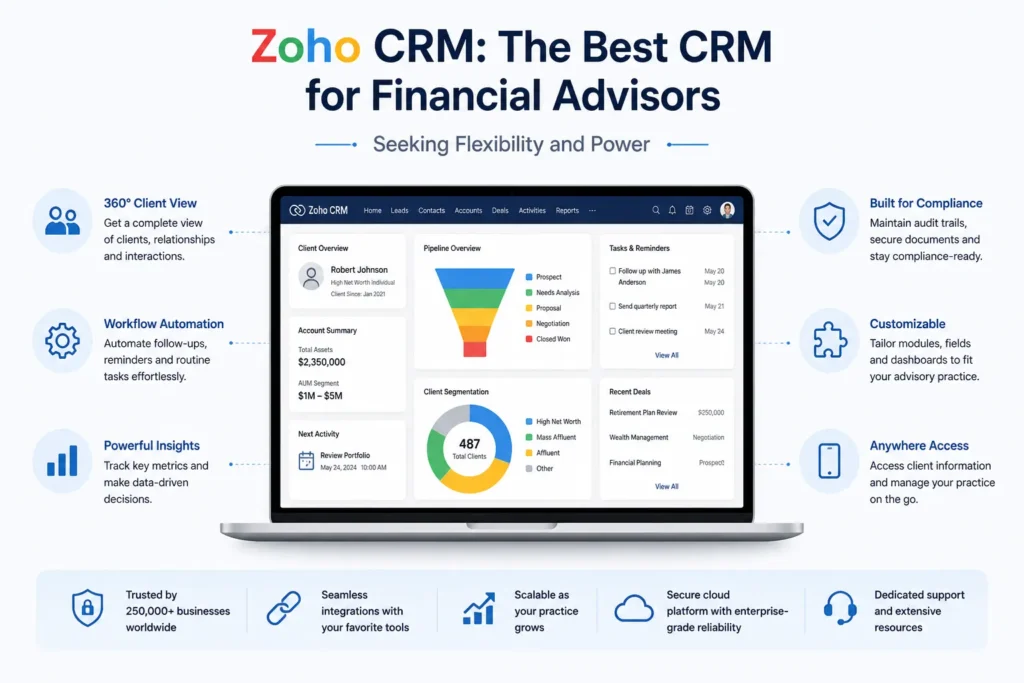
Among all the CRM platforms available today, Zoho CRM consistently stands out for its combination of deep customization, intelligent automation, and enterprise-grade features at a price point that works for practices of all sizes.
As a Zoho Premium Partner, we’ve implemented Zoho CRM for financial advisory firms and witnessed firsthand how it reshapes operations, cutting manual admin time, improving client engagement, and creating the structured processes that allow practices to scale with confidence.
Here’s a closer look at what makes Zoho CRM the best CRM for financial advisors:
1. Built for Financial Services:
Zoho CRM gives you complete control over how your data is structured. Build dedicated modules for KYC documentation, risk assessments, investment plans, and policy renewals, then configure custom fields, page layouts, and views that match exactly how your team works. No workarounds, no forcing financial workflows into a sales-first template.
2. Zia AI Keeps You Proactive
Zia monitors your entire client database in the background, identifying who hasn’t been contacted recently, spotting data inconsistencies, and recommending the right time to reach out based on individual response patterns. For advisors managing hundreds of relationships, this passive intelligence keeps service quality high without burning out your team.
3. Consistency at Every Client Stage
Blueprint codifies your ideal client journey, from first inquiry through onboarding, portfolio reviews, and long-term retention, and enforces it automatically. Each stage triggers the next set of tasks, emails, or document requests. New hire or senior advisor, the client experience stays identical.
4. Every Interaction, Automatically Logged
Every call, email, WhatsApp message, and SMS exchange is captured against the client’s profile the moment it happens. Your team always walks into interactions with full context, no inbox digging, no asking colleagues what was last discussed.
5. Always Audit-Ready
Role-based permissions, time-stamped activity logs, and Zoho Sign integration keep your compliance infrastructure solid under SEBI, IRDAI, or AMFI frameworks. Every signed agreement and disclosure is stored directly inside the client’s profile, retrievable in seconds, not hours.
6. Dashboards That Drive Decisions
Real-time visibility into AUM distribution, pipeline health, advisor productivity, and campaign ROI replaces guesswork with clarity. Build custom reports around your practice’s KPIs and share them with stakeholders without any manual preparation.
7. One Fully Connected Ecosystem
Zoho Integration Services link Zoho CRM natively with Zoho Books, Zoho Campaigns, Zoho Desk, and Zoho Analytics. Zapier, Microsoft 365, and Google Workspace cover everything beyond the Zoho ecosystem, so your entire practice runs from one connected platform.
Also Read: How Zoho Sign and Zoho Desk Help You Cut Customer Service Paperwork
Which CRM Should You Choose?
The right CRM depends on your firm’s size, budget, and priorities. Salesforce FSC is built for large enterprises. Wealthbox works best for teams that need fast adoption. Redtail delivers the best value for compliance-heavy established teams. HubSpot is the go-to for marketing-driven practices.
For most growing financial advisory practices, Zoho CRM is the strongest choice. It scales with your practice, adapts to your workflow, and delivers more capability per dollar than any other platform on this list. The Zoho ecosystem alone eliminates the need for multiple standalone tools, and Blueprint ensures your processes run consistently with or without you in the room.
Choosing the right CRM is one of the most important technology decisions your practice will make. As a Zoho Partner, we help financial advisors evaluate, implement, and get the most out of Zoho CRM from day one.
Ready to find the right CRM for your practice? Contact us today for a free evaluation.
FAQ
Q1. Is a cloud-based CRM safe for storing sensitive client financial data?
Ans. Yes, provided the platform meets industry security standards. Look for CRMs that offer data encryption, role-based access controls, two-factor authentication, and regular security audits. Leading platforms like Zoho CRM, Salesforce FSC, and Wealthbox all meet enterprise-level requirements.
Q2. How can I integrate CRM with other financial tools?
Ans. Most CRMs connect with financial tools through native integrations, APIs, or Zapier. Key integrations for financial advisors include email platforms, custodian systems, financial planning software, and digital signature tools. Zoho CRM covers most of these natively, with the remaining tools accessible via Zapier or API.
Q3. What is the Zoho ecosystem, and how does it benefit financial advisors?
Ans. The Zoho ecosystem includes Zoho Books, Zoho Sign, Zoho Campaigns, and Zoho Analytics, all natively connected to Zoho CRM under one login, eliminating the need for multiple standalone tools.
Q4. Can I migrate my existing client data to a new CRM without losing anything?
Ans. Yes. CRM Masters supports structured data migration, including contacts, interaction history, and documents. Working with an implementation partner significantly reduces the risk of data loss or disruption during the switch.