



What is Account Based Marketing & How it Close Bigger Deals
Most B2B sales teams work hard. They run campaigns, follow up on leads, and push to hit their numbers every quarter. But here is the problem: a lot of that effort goes toward the wrong accounts. They chase cold leads that never convert. They spend marketing budgets on people who were never going to buy. And the accounts that actually have the potential to grow? They often get the least attention. This is exactly the problem that Account Based Marketing (ABM) can solve. Zoho CRM has been steadily improving, launching six new updates released in 2026 that make the feature more powerful and easier to use than ever.
McKinsey research found that 71% of consumers expect personalized interactions and 76% get frustrated when that does not happen. For B2B executives and decision-makers, that expectation is even higher.
In this blog, we break down what ABM is, why it works, and how the new Zoho CRM ABM add-on can help your team drive more revenue without wasting time or budget.
What is Account Based Marketing?
Account based marketing is a B2B growth strategy where your sales and marketing teams work together to target specific high-value accounts rather than focusing on traffic volume.
ABM focuses on closing high-quality leads with maximum return on investment (ROI). It builds personalized campaigns designed specifically for those accounts and focuses on a data-driven approach to work well for B2B companies with longer sales cycles and high-volume contracts.
The ABM process typically looks like this:
- Identify your best-fit, highest-value accounts
- Enrich those accounts with data to understand them better
- Segment them based on industry, revenue, behavior, or other criteria
- Build targeted campaigns tailored to each segment
- Engage, nurture, and convert at scale
Why Are B2B Teams Switching to Account Based Marketing?
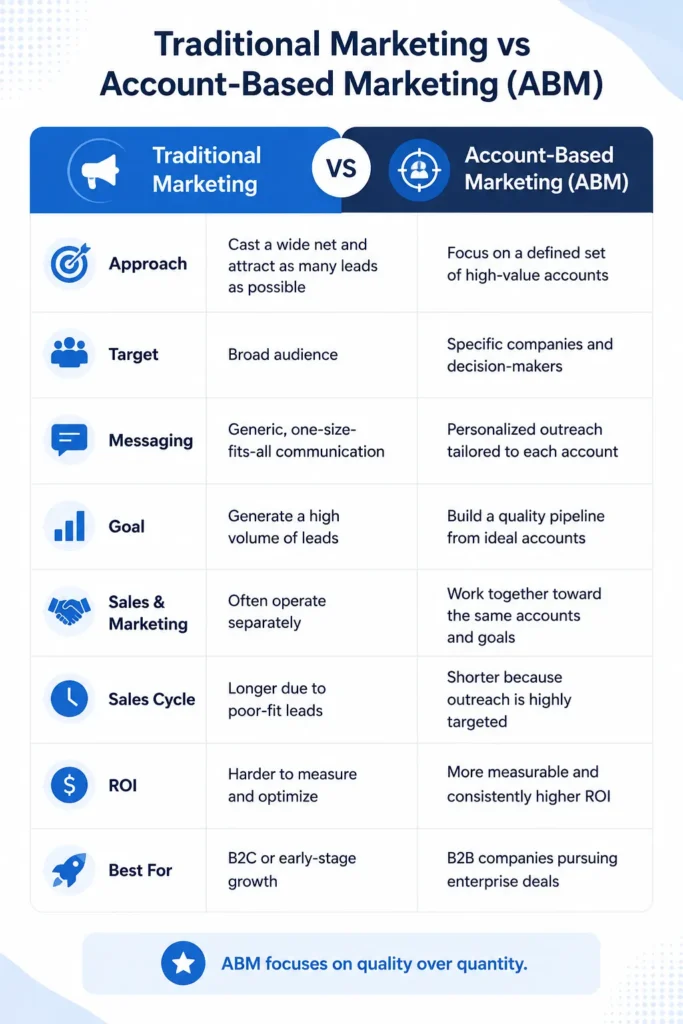
Traditional lead generation has a volume problem. You can bring in thousands of leads, but if most of them are the wrong fit, your team wastes time qualifying, chasing, and eventually disqualifying them.
ABM solves this by focusing on quality over quantity. Here is why more B2B teams are making the shift:
1. Better ROI on Marketing Spend
When you target fewer, better-fit accounts, your marketing budget goes further. You are not wasting money on audiences that will never convert.
2. Shorter Sales Cycles
Personalized outreach that speaks directly to an account’s needs builds trust faster. Prospects move through the funnel more quickly when they feel understood.
3. Sales and Marketing Work Together
ABM forces both teams to align on the same target accounts, the same messaging, and the same goals. No more working in silos.
4. More Value from Existing Accounts
It is much easier to sell to someone who already knows and trusts you. ABM helps you identify upsell and cross-sell opportunities within your existing customer base, which is one of the fastest ways to grow revenue.
Also Read: How to Build an End-to-End Sales Funnel with Zoho Apps
Account Based Marketing vs Traditional Marketing: What Is the Difference?
Account Based Marketing in Zoho CRM
Zoho launched the ABM add-on as part of its Q1 2025 updates, and it is built specifically to help businesses drive greater value from their existing accounts while also identifying new high-potential targets.
What makes this add-on different from a standalone ABM tool is that it lives inside your CRM. Your account data, deal history, and engagement records are all right there. No syncing, no switching tools, no data gaps.
(PS: It is currently available for standalone CRM subscriptions in Enterprise and Ultimate editions.)
Need help figuring out the right Zoho CRM plan for your team? Our Zoho Consulting Services can help you assess and choose the best fit.
Six New Updates to Account Based Marketing in Zoho CRM
Zoho announced 6 enhancements to the ABM features in Zoho CRM in April 2026. These updates are designed to make ABM more accessible, more flexible, and more powerful for teams of all sizes.
Here are the new updates:
1. ABM is Now in Zoho CRM
ABM has been moved from the marketplace to Zoho CRM’s native interface. This means you no longer need to install it separately. It is available directly via a switcher inside the CRM, making it much faster to access.
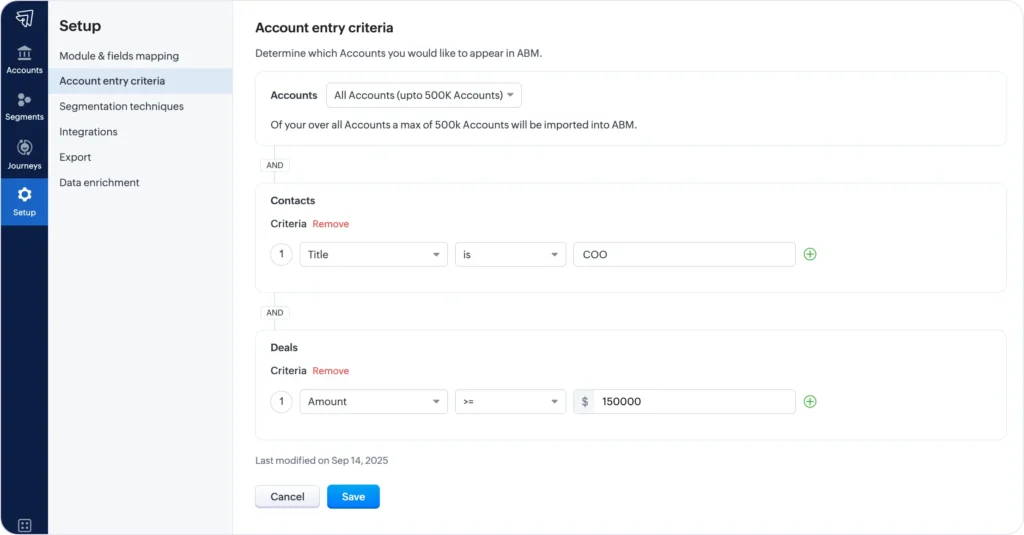
2. Account Entry Criteria
The term “global criteria” has been renamed to “account entry criteria” to better reflect what it actually does. This is a small but meaningful change that makes the setup process easier to understand, especially for teams that are new to ABM.
Picture Source: Zoho
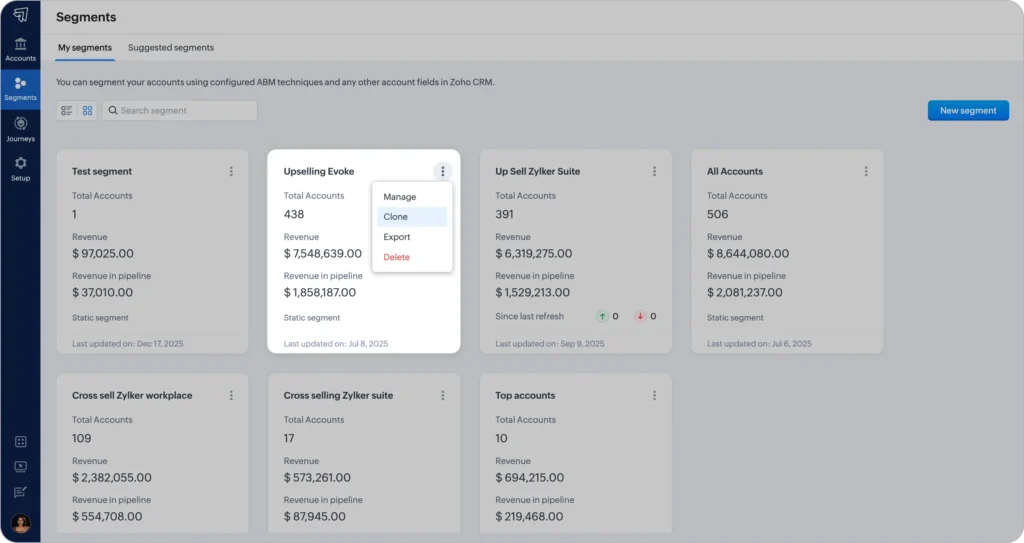
3. Clone Existing Segments in One Click
You can now clone existing segments instead of building new ones from scratch. If you have a segment that is working well and you want to create a similar one with slightly different criteria, this feature saves significant time and effort. It is a practical update that will make a real difference for teams managing multiple segments.
Picture Source: Zoho
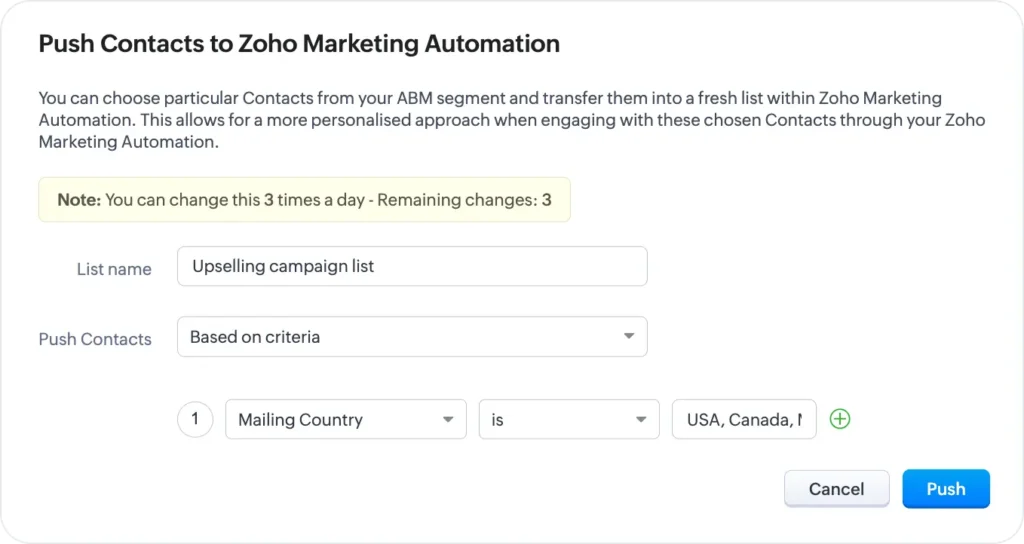
4. Sync ABM Segments with Zoho Marketing Automation
ABM segments can now be synchronized with contact lists in Zoho Marketing Automation. This means your target accounts move seamlessly into your automation workflows, enabling more effective and timely nurturing of those accounts without any manual export or import.
Picture Source: Zoho
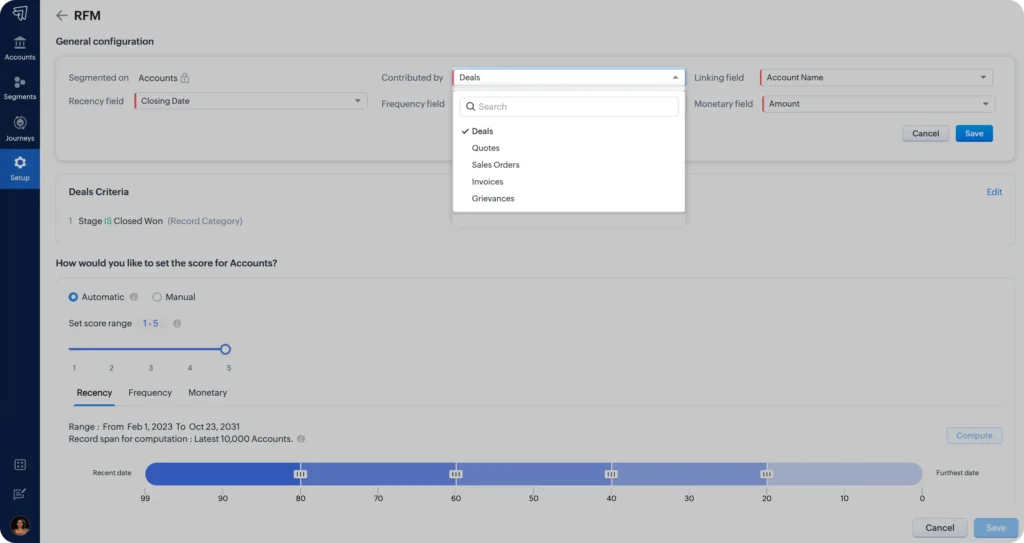
5. Flexible Contribution Module in RFM
RFM (Recency, Frequency, Monetary) scoring is one of the most useful ways to segment accounts by value. Previously, the contribution module used to calculate the RFM value was fixed. Now you can select which module, such as Deals, Sales Orders, or Quotes, is used to calculate RFM values.
Picture Source: Zoho
6. More Limits for Segments & Journey
Zoho has also increased the limits on the number of segments and journeys organizations can maintain. For growing teams managing a large number of accounts and campaigns, this update removes a ceiling that may have been holding them back.
How Account Based Marketing in Zoho CRM Drives Revenue
These updates make ABM in Zoho CRM faster to set up, easier to manage, and more connected to the rest of your Zoho ecosystem.
Here is the direct revenue impact:
1. Faster Activation Means Faster Results
With ABM now native to the CRM, your team can get started without any additional setup. Less friction means your campaigns get off the ground sooner.
2. Better Segmentation Leads to Better Campaigns
Using Contacts and Deals data to refine account selection, combined with flexible RFM contribution modules, means your segments are more accurate. More accurate segments lead to more relevant campaigns. More relevant campaigns lead to higher conversion rates.
3. Connected Automation Keeps Accounts Engaged
Syncing ABM segments with Zoho Marketing Automation means your target accounts never fall through the cracks. They stay in active nurturing sequences that move them closer to a decision.
Also Read: What Is Marketing Automation and How Does It Help in Lead Generation
Who Should Use Account Based Marketing?
Account Based Marketing is not for every business. It works best when your sales process involves high-value deals, multiple decision-makers, and a longer buying cycle. If any of the following describe your business, ABM is likely a strong fit.
1. You Sell to Other Businesses
ABM is built for B2B. If your customers are companies rather than individual consumers, ABM gives you a structured way to target the right organizations and reach the right people within them.
2. Your Average Deal Size Is High
When a single closed deal is worth tens of thousands or hundreds of thousands of dollars, it makes sense to invest significant time and resources into winning that account. ABM justifies that investment by making sure every effort is directed at accounts with real revenue potential.
3. Your Sales Cycle Is Long
If it takes weeks or months to close a deal, you need a strategy that keeps prospects engaged throughout the process. ABM does this through personalized, consistent outreach that moves multiple stakeholders forward at the same time.
4. You Have a Defined Ideal Customer Profile
ABM works best when you know exactly what a good-fit account looks like. If you can describe your ideal customer by industry, company size, revenue, or geography, you have what you need to build a strong ABM target list.
5. Your Sales and Marketing Teams Are Ready to Align
ABM requires both teams to work toward the same goals. If your sales and marketing teams are willing to collaborate on account selection, messaging, and campaign execution, ABM will deliver far better results than working in silos.
6. You Are on Zoho CRM Enterprise, Ultimate, or CRM Plus
If you are already using Zoho CRM on a qualifying plan with 15 or more licenses, you have everything you need to get started with ABM right now without any additional tools or integrations.
Want to Set Up Zoho CRM?
ABM is not just a marketing trend. It is a proven revenue strategy, and the April 2026 updates to Zoho CRM ABM make it more practical and more powerful than ever for B2B teams.
If you need help setting up, configuring, or migrating to Zoho CRM so you can take full advantage of ABM, the team at CRM Masters is ready to help. We work with B2B teams to set up and optimize their Zoho CRM so they can get to revenue faster.
Get in touch with CRM Masters today and let us help you make the most of ABM in Zoho CRM.
FAQ
Q1. Who should use account based marketing?
Ans. ABM works best for B2B companies that sell high-value products or services, have longer sales cycles, and deal with multiple decision-makers within a single account. It is particularly effective for mid-size to enterprise teams.
Q2. What is the real difference between ABM and traditional lead generation?
Ans. Traditional lead generation focuses on attracting a large number of leads and then filtering them. Account Based Marketing starts by identifying the right accounts and then building campaigns specifically for them. ABM is more targeted, more personalized, and typically delivers a higher return on investment.
Q3. Do I need to install ABM separately in Zoho CRM?
Ans. No. As of April 2026, ABM is now native to Zoho CRM and accessible directly via a switcher inside the platform. You no longer need to install it from the Marketplace.
Q4. What is RFM scoring in ABM?
Ans. RFM stands for Recency, Frequency, and Monetary value. It is a scoring model that helps you rank and segment accounts based on how recently they engaged, how often they interact, and how much revenue they generate. Zoho CRM now lets you choose which module, such as Deals, Sales Orders, or Quotes, is used to calculate these values.