



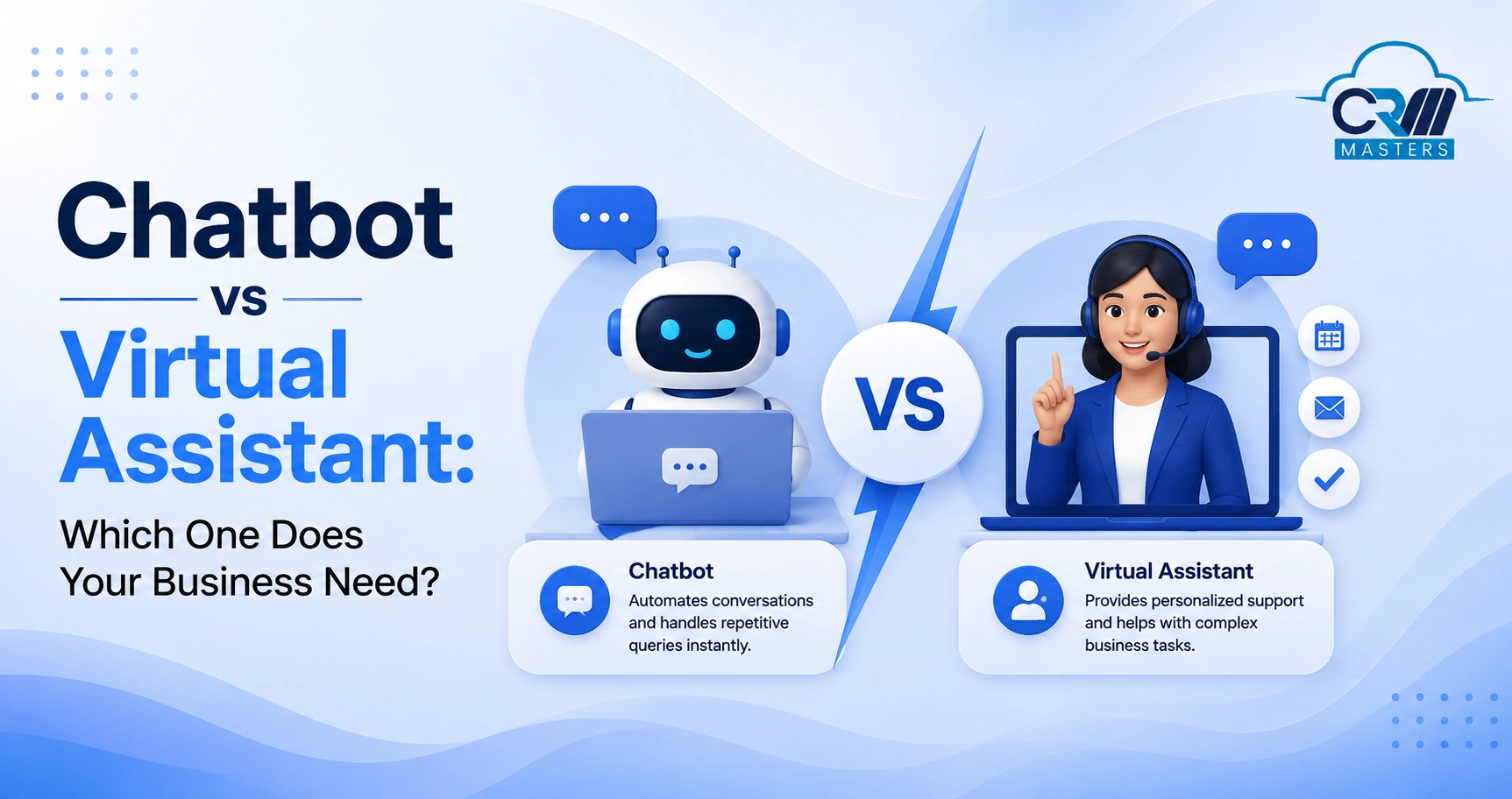
Chatbot vs Virtual Assistant: Which One Does Your Business Need?
Artificial intelligence has changed the way businesses communicate with customers. Just a few years ago, most online conversations with businesses were limited to simple chat windows that could answer a handful of predefined questions. Today, AI can understand natural language, provide personalized responses, retrieve information from business systems, and even complete tasks without human intervention.
As these technologies become more common, terms like chatbot, AI chatbot, virtual assistant, and AI assistant are often used interchangeably. While they all help automate conversations, they are not the same. Understanding the difference is important because choosing the right solution can improve customer experience, increase team productivity, and reduce repetitive work.
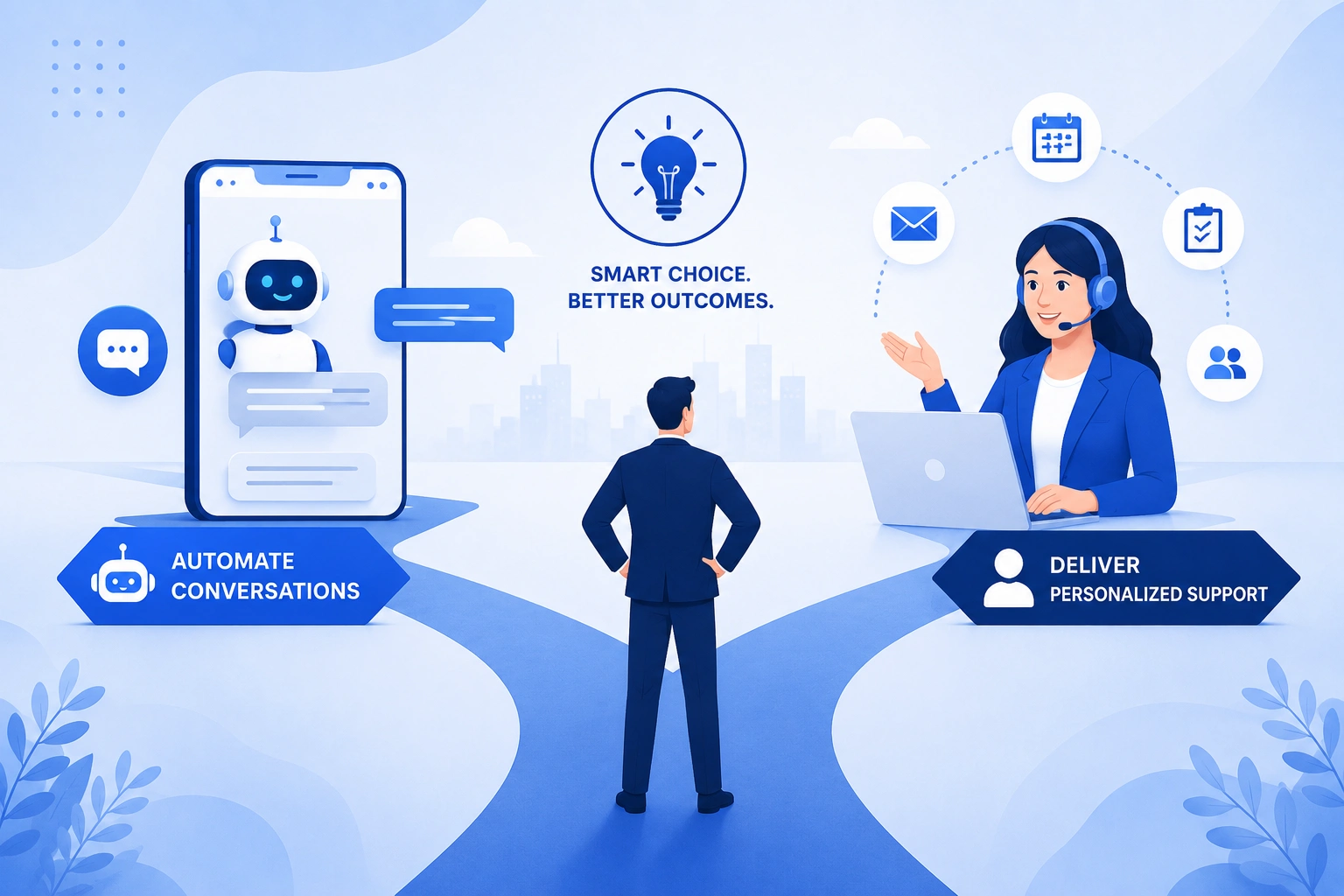
The good news is that businesses no longer have to choose between automation and personalization. Modern AI solutions make it possible to deliver both. The key is knowing which technology aligns with your goals.
In this blog, we’ll explore how chatbots and virtual assistants differ, how Large Language Models (LLMs) have transformed conversational AI, and what businesses should consider before investing in either solution.
🔑 Key Takeaways
- A chatbot helps people find information. A virtual assistant helps people get things done.
- Chatbots are great for FAQs, lead capture, appointment booking, and order tracking simple, predictable conversations.
- Virtual assistants go further by connecting to business systems, retrieving data, and completing actions like updating a CRM or scheduling a meeting.
- LLMs (Large Language Models) are the reason both chatbots and virtual assistants sound more natural and understand context today.
- The real value comes from integration. An AI tool connected to your CRM is far more useful than one working off general knowledge alone.
- Don’t pick based on the technology trend. Pick based on what your business actually needs: simple Q&A automation, or task-level automation across your workflows.
- The next wave is AI agents, tools that don’t just respond, but complete entire workflows on their own, from follow-ups to CRM updates to notifications.
Why the Difference Matters Today
Customer expectations have evolved quickly.
People expect instant responses when they visit a website, send a message, or request support. At the same time, they also expect those responses to feel relevant and personal. They don’t want to explain the same issue multiple times or wait hours for someone to reply to a simple question.
For businesses, meeting these expectations isn’t always easy. Customer support teams are managing more conversations than ever, while sales teams are expected to respond to new leads almost immediately. Relying entirely on manual communication can slow down operations and increase costs.
This is why conversational AI has become an important part of modern business. Instead of replacing people, it helps teams focus on higher-value work by automating repetitive conversations and routine tasks.
However, not every AI solution offers the same capabilities. A chatbot designed to answer frequently asked questions serves a very different purpose from a virtual assistant that can understand context, access business data, and automate workflows.
What Is a Chatbot?
A chatbot is a software application that interacts with users through text or voice. Its primary purpose is to answer questions, guide users through simple processes, and provide information without requiring human intervention.
The earliest chatbots followed predefined rules. They worked by matching keywords or guiding users through decision trees. These bots could answer common questions such as business hours, pricing, shipping information, or appointment availability, but they struggled when conversations became more complex.
Today’s chatbots have become much smarter.
Many now use artificial intelligence and natural language processing to understand how people naturally communicate instead of relying only on exact keywords. This allows users to ask questions in different ways while still receiving accurate responses.
For example, these questions all have the same intent:
- “How much does your service cost?”
- “Can I get a pricing estimate?”
- “What’s your pricing like?”
A modern AI chatbot can recognize that all three questions relate to pricing and respond appropriately.
This makes conversations feel much more natural than older rule-based systems.
Where Chatbots Work Best
Chatbots are particularly effective when conversations follow predictable patterns. Businesses commonly use them for:
- Answering frequently asked questions
- Capturing leads from website visitors
- Booking appointments
- Sharing product information
- Tracking orders
- Collecting customer details before transferring conversations to a support team
They can also reduce the workload on customer service teams by handling repetitive requests that don’t require human judgment.
For many small and growing businesses, a well-designed chatbot is often the first step toward customer service automation.
How Chatbots Have Evolved with AI
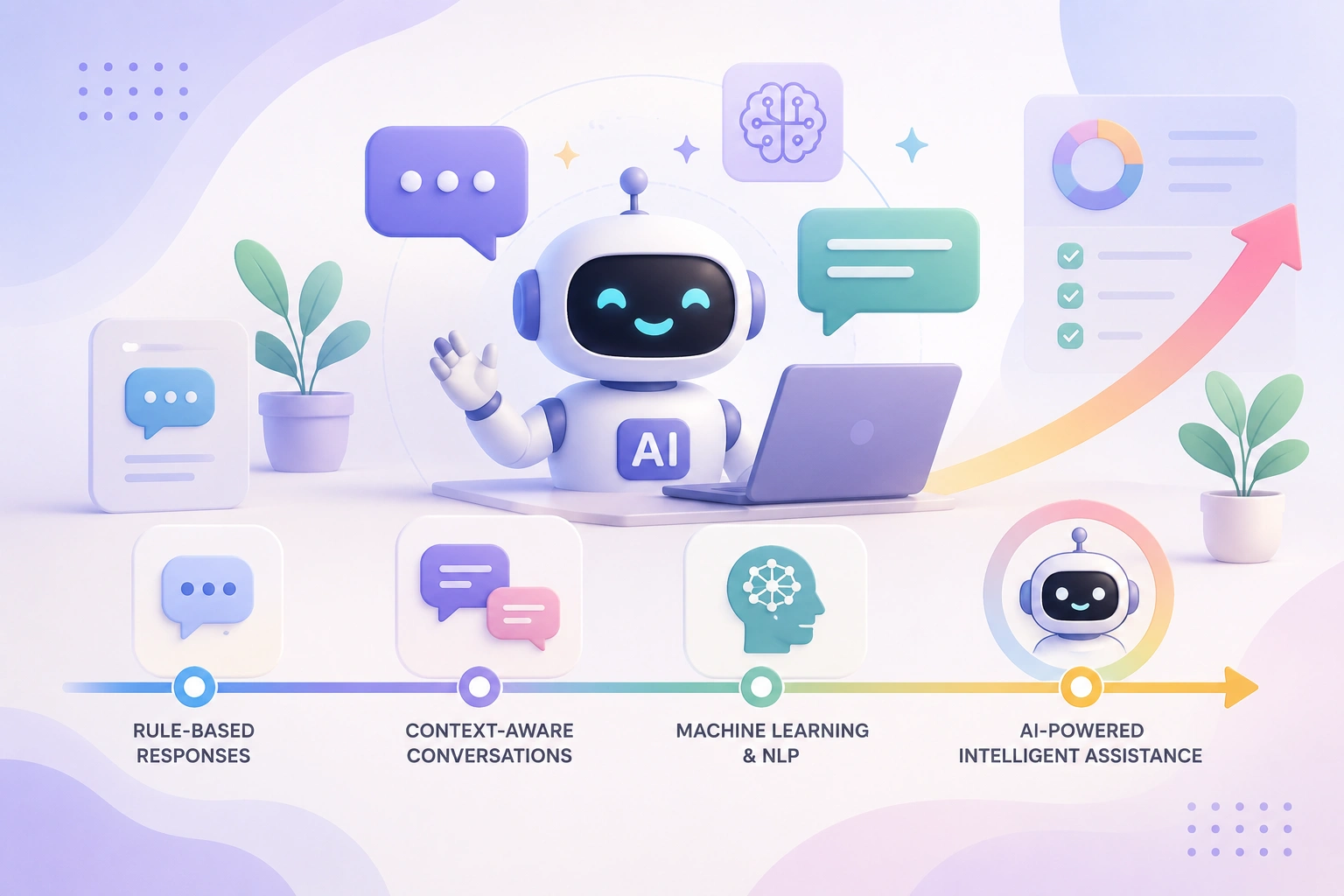
One of the biggest changes in recent years has been the introduction of Large Language Models, commonly known as LLMs.
An LLM is an AI model trained on vast amounts of text, allowing it to understand language, recognize context, and generate responses that sound much more natural than traditional chatbots.
Instead of following a fixed script, AI-powered chatbots can now:
- Understand conversational language
- Ask follow-up questions when information is missing
- Summarize customer requests
- Provide more personalized responses
- Adapt to different conversation styles
This doesn’t mean every chatbot uses an LLM, but many modern conversational AI platforms are beginning to incorporate this technology to improve customer interactions.
The result is a chatbot that feels less like a menu system and more like an intelligent conversation partner.
What Is a Virtual Assistant?
A virtual assistant takes conversational AI a step further.
While a chatbot is primarily designed to answer questions and guide conversations, a virtual assistant is designed to help users complete tasks.
Instead of simply providing information, it can understand requests, access connected systems, retrieve relevant data, and perform actions across multiple business applications.
Imagine a customer says:
“I’d like to reschedule tomorrow’s product demo and invite my colleague to the meeting.”
A chatbot might respond with instructions on how to contact the sales team.
A virtual assistant could check calendar availability, update the meeting, send a new invitation, and record the activity in the company’s CRM, all within the same conversation.
The difference is not just better conversation. It’s the ability to take meaningful action.
What Makes Virtual Assistants Different?
Modern virtual assistants rely on more than conversational AI. They combine LLMs with business logic, APIs, and integrations to work alongside existing business systems.
Depending on how they’re configured, they can:
- Retrieve customer information from a CRM
- Schedule meetings
- Create support tickets
- Update sales opportunities
- Generate summaries after customer interactions
- Trigger workflow automations
- Help employees find internal documents or company policies
This makes virtual assistants valuable not only for customer support but also for sales, operations, and internal productivity.
Rather than acting as a standalone tool, they become part of a connected business ecosystem.
For organizations already using platforms like Zoho CRM, a virtual assistant can access customer information during conversations, helping sales and support teams respond more efficiently. When combined with tools such as Zoho SalesIQ or Zoho Zia, businesses can create more personalized customer experiences while reducing repetitive manual work.
However, a virtual assistant is not always the right answer. For many businesses, a chatbot remains the simpler and more cost-effective solution for handling routine conversations.
The key is understanding where each technology delivers the greatest value.
Also Read: Zoho SalesIQ and Zoho CRM Integration
Chatbot vs Virtual Assistant: A Side by Side Comparison
While both technologies are designed to improve conversations and reduce manual work, their capabilities are quite different. Choosing the right one depends on what you expect it to do.
| Feature | Chatbot | Virtual Assistant |
|---|---|---|
| Primary purpose | Answers questions and guides conversations | Understands requests and performs tasks |
| Intelligence | Rule-based or AI-powered | AI-powered with reasoning capabilities |
| Understands context | Limited | Yes |
| Learns from conversations | Limited | Can use conversation history and business context |
| Integrates with business systems | Basic integrations | Deep integrations with CRM, ERP, calendars, email, and more |
| Workflow automation | Limited | Extensive |
| Best suited for | FAQs, lead capture, appointment booking | Customer support, sales assistance, internal productivity, business automation |
The easiest way to think about it is this:
- A chatbot helps people find information.
- A virtual assistant helps people get things done.
For businesses with few customer inquiries, a chatbot is often enough. But when conversations become more personalized and require access to business data, a virtual assistant becomes far more valuable.
Real Business Examples
Understanding the difference becomes easier when you look at real business scenarios.
Retail and Ecommerce
- A customer visits an online store and asks whether a particular product is available in a different size.
- A chatbot can quickly check product availability or direct the customer to the relevant page.
- A virtual assistant can go a step further by checking inventory across multiple locations, recommending similar products if the item is unavailable, applying eligible discounts, and creating a follow-up reminder if the product comes back in stock.
Manufacturing
- A distributor wants to know the delivery status of an order.
- A chatbot may ask for the order number and provide a tracking link.
- A virtual assistant can retrieve shipment details from connected systems, estimate the delivery date, notify the account manager about the inquiry, and create a support case if there is an unexpected delay.
Professional Services
- A consulting firm receives dozens of inquiries every week.
- A chatbot can answer questions about services, office hours, or consultation fees.
- A virtual assistant can qualify leads by asking relevant questions, schedule discovery calls, assign opportunities to the right consultant, and automatically create records in the CRM.
Internal Business Operations
- Conversational AI is no longer limited to customer support.
- Employees also benefit from virtual assistants.
- Instead of searching through emails or internal documentation, employees can ask questions like:
“What’s our leave policy?”
“Show me last month’s sales report.”
“Create a task for tomorrow’s client meeting.”
A virtual assistant can retrieve information from connected business systems and complete these requests without employees switching between multiple applications.
How Large Language Models Have Changed Conversational AI
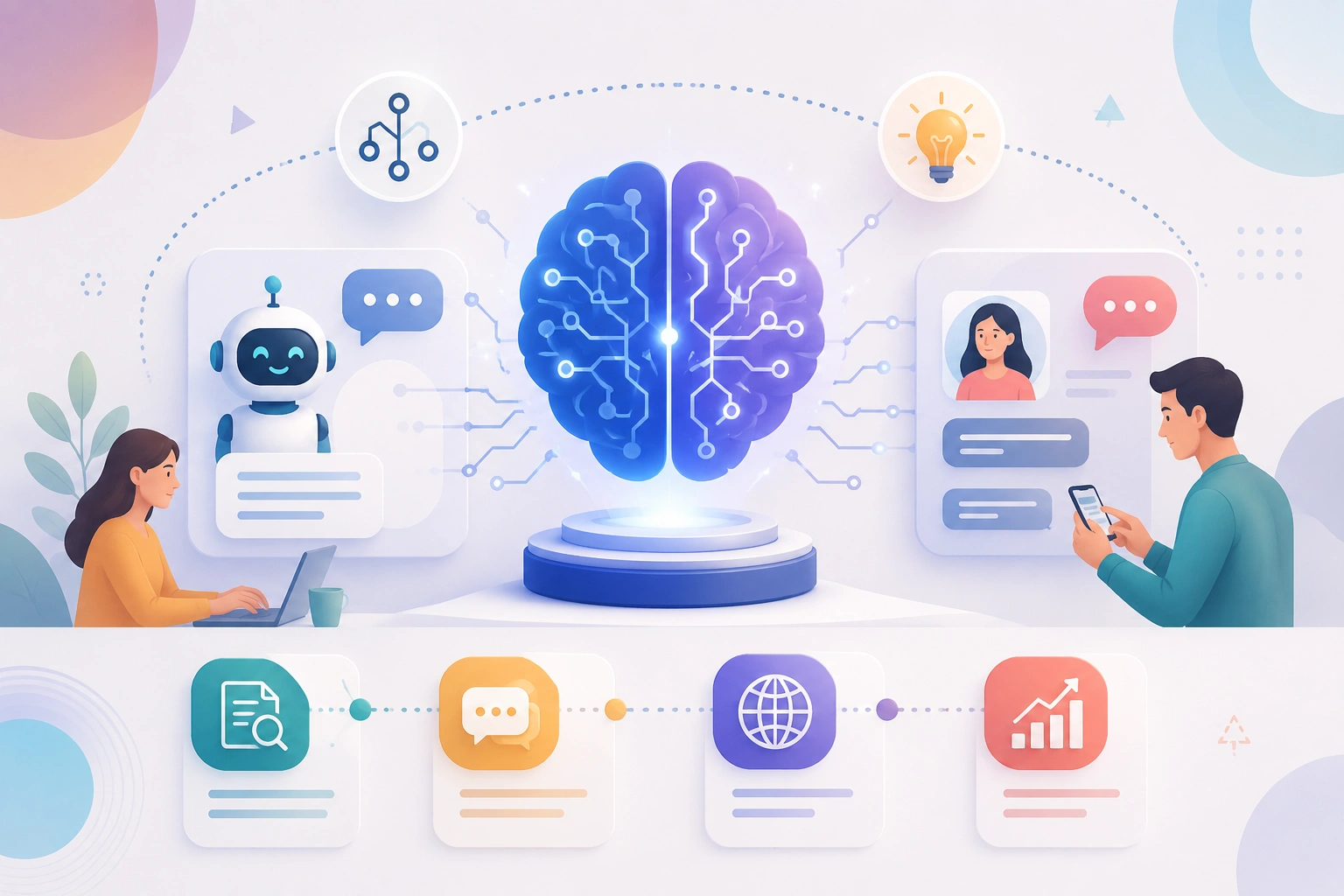
One of the biggest reasons virtual assistants have become significantly more capable is the advancement of Large Language Models (LLMs).
In simple terms, an LLM is an AI model trained to understand and generate human language. It doesn’t simply search for keywords. Instead, it looks at the context of a conversation to understand what the user actually means.
For businesses, this brings several advantages.
AI can now understand follow-up questions without requiring customers to repeat themselves. It can summarize lengthy conversations for support agents, generate professional responses, and explain complex information in a way that’s easier to understand.
However, it’s important to remember that an LLM is only one part of the solution.
To be truly useful in a business environment, it also needs access to accurate and up-to-date information. This is where integrations with CRM platforms, knowledge bases, and business applications become essential.
For example, an AI assistant that can access customer records, order history, and product documentation is far more helpful than one relying only on general knowledge.
💡 Our Recommendation
Don’t choose based on technology. Choose based on your business processes.
Go with a Chatbot if:
Your goal is to answer common questions, reduce repetitive support requests, or capture leads outside business hours.
Go with a Virtual Assistant if:
You want AI to retrieve customer information, automate workflows, schedule meetings, update CRM records, and support employees across different systems.
The Future of Business Assistants
Conversational AI continues to evolve rapidly, and the next few years will bring even more intelligent business assistants.
One of the biggest trends is the rise of AI agents.
Unlike traditional assistants that wait for instructions, AI agents are designed to complete entire workflows with minimal human involvement. They can break a task into multiple steps, interact with different applications, make decisions based on predefined rules, and report the outcome.
For example, instead of simply reminding a sales representative to follow up with a prospect, an AI agent could:
- Review recent customer interactions.
- Draft a personalized follow-up email.
- Schedule the next meeting based on calendar availability.
- Update the CRM.
- Notify the sales manager after the task is completed.
We’re also seeing rapid improvements in multimodal AI, where assistants can understand not only text but also images, documents, voice conversations, and even videos.
Another important trend is persistent memory. Instead of treating every interaction as a new conversation, AI assistants will remember previous discussions, customer preferences, and ongoing projects, making interactions more natural and productive.
As businesses continue adopting AI, success will depend less on having the latest model and more on connecting AI with reliable business data and clearly defined workflows.
Building Smarter Conversations with CRM
A chatbot or virtual assistant becomes much more useful when it’s connected to your CRM.
Instead of asking customers to repeat information, AI can recognize returning contacts, retrieve previous interactions, and provide responses based on existing customer data.
Businesses using platforms like Zoho CRM can combine customer information with conversational AI to create more personalized experiences across sales, marketing, and support.
Solutions such as Zoho SalesIQ allow businesses to engage website visitors in real time, while Zoho Zia adds AI-powered insights and automation that help teams work more efficiently.
The real value comes from connecting these tools with existing business processes rather than using them as standalone applications.
This is where implementation becomes important. Every business has different workflows, approval processes, and customer journeys. Configuring AI around those requirements helps ensure it delivers meaningful results instead of creating another disconnected tool.
At CRM Masters, we’ve seen that successful AI adoption is rarely about adding another chatbot to a website. It’s about understanding business processes first, then integrating AI with CRM, automation, and customer engagement tools so teams can work more efficiently while delivering a better customer experience.
FAQ
Q1. Can a chatbot become a virtual assistant?
Ans. Some AI-powered chatbots include advanced features that make them behave like virtual assistants. The distinction depends on their ability to perform tasks, access business systems, and automate workflows rather than simply answer questions.
Q2. Are virtual assistants powered by Large Language Models?
Ans. Many modern virtual assistants use LLMs to understand natural language and generate responses. They often combine these models with CRM data, business rules, and integrations to provide more accurate and useful assistance.
Q3. Is a virtual assistant better than a chatbot?
Ans. Not always. If your primary goal is to answer frequently asked questions or capture leads, a chatbot may be the simpler and more cost-effective choice. A virtual assistant becomes more valuable when conversations involve business data, workflow automation, or complex requests.
Q4. Can conversational AI integrate with CRM systems?
Ans. Yes. Many conversational AI platforms integrate with CRM solutions, allowing businesses to retrieve customer information, update records, assign leads, and automate follow-up activities during conversations.
Q5. Which Zoho applications support conversational AI?
Ans. Businesses using Zoho can combine Zoho CRM, Zoho SalesIQ, and Zoho Zia to deliver AI-assisted conversations, visitor engagement, customer insights, and workflow automation within a connected ecosystem.
Q6. Is conversational AI replacing customer support teams?
Ans. No. The goal of conversational AI is to reduce repetitive work and help teams respond faster. Human expertise remains essential for complex issues, relationship building, strategic decision making, and situations that require empathy or negotiation.