




How to Set Up Zoho FSM: A Complete Step-by-Step Guide (2026)
Managing a field service team without the right system means missed appointments, manual paperwork, slow invoicing, and dispatchers making scheduling decisions with incomplete information. Zoho FSM is built to fix exactly that, and this guide walks you through how to set it up correctly, from first login to your first completed work order.
What is Zoho FSM?
Zoho FSM (Field Service Management) is a cloud-based platform that automates the complete lifecycle of field service operations, from logging service requests and scheduling technicians to dispatching jobs, generating invoices, and collecting on-site payments. It is purpose-built for companies that send technicians to customer sites: HVAC, IT support, cleaning and facilities management, medical equipment maintenance, solar installation, utilities, and telecommunications.
Unlike a general CRM, Zoho FSM includes modules specifically designed for territory management, skill-based technician matching, job sheet documentation, recurring maintenance planning, and integrated invoicing through Zoho Books. Its pricing is volume-based per service appointment; you pay for the appointments you create, not a flat per-user licence, making it cost-efficient for field teams of any size.
Zoho FSM sits inside the Zoho ecosystem and extends Zoho CRM, Zoho Desk, and Zoho Books without requiring a full Zoho One subscription. For businesses already on Zoho One, FSM is included in the suite.
How Does Zoho FSM Differ from Zoho CRM?
Zoho CRM manages sales pipelines and customer relationships. Zoho FSM manages what happens after the sale, the service delivery itself. While the two share a similar interface, their modules serve completely different purposes: Work Orders replace Deals; Service Appointments replace Tasks; the Dispatch Console replaces the sales Activity Calendar.
The two platforms complement each other through the Zoho FSM extension for Zoho CRM, which syncs customer data and lets sales teams trigger field service requests directly from CRM records, creating a clean handoff from sales to service. If your business is evaluating how to connect these systems, our Zoho Integration Services team can help you design the right architecture.
Zoho FSM Core Module Overview
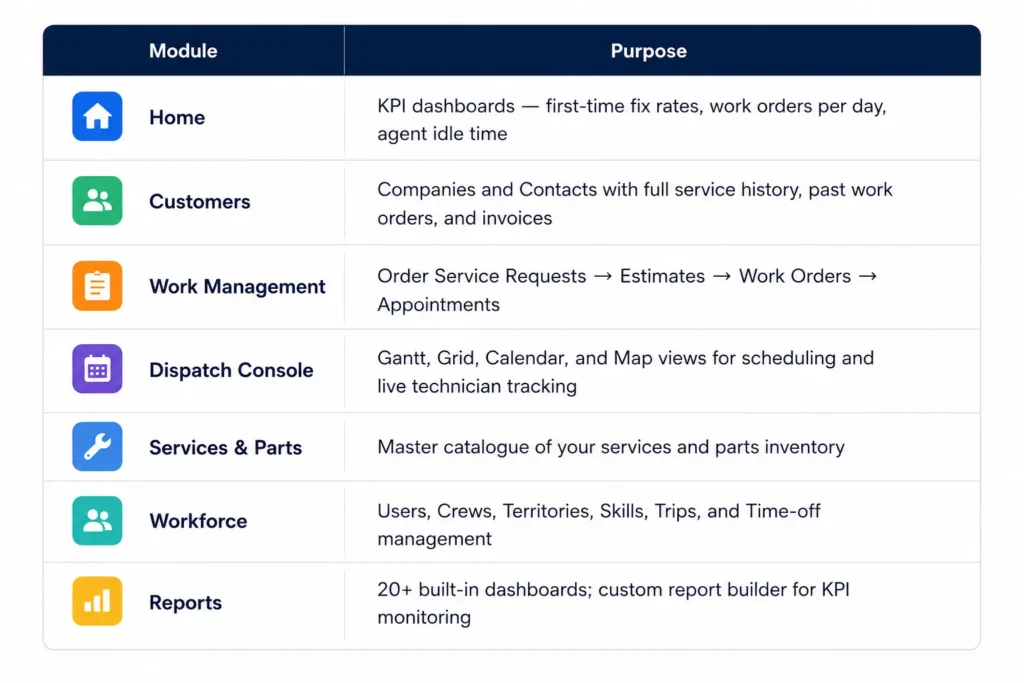
Zoho FSM is organised into seven modules. Understanding this structure before setup saves significant configuration time.
Key Benefits of Zoho FSM
1. Automate Work Order Processing
Work Order Management automates incoming service requests, removing the manual data entry that slows down field operations. Tasks are assigned based on technicians’ skills and geographic territories, reducing response times. Frequently requested services can be templated for one-click processing, significantly cutting turnaround time on repeat jobs.
2. Improve First-Time Fix Rates
By matching the right technician, based on skills and location, to each job, and giving them access to job history and asset information through the mobile app before they arrive on-site, Zoho FSM directly improves first-time fix rates. This is one of the most watched KPIs in field service, directly tied to customer satisfaction and cost per job.
3. Manage a Mixed Workforce
Zoho FSM supports five distinct user profiles: Administrator, Call Centre Agent, Dispatcher, Field Agent, and Limited Field Agent. Critically, it separates Users (who log in to the system) from Crew (workers who can be scheduled but don’t need system access) — essential for businesses that use subcontractors or casual field workers alongside permanent staff.
4. Reduce Billing Cycles
With Zoho Books integration, completed work orders convert directly to branded invoices. Online payment links can be sent to customers the moment the job is marked complete, collapsing the time between service delivery and revenue recognition.
5. Communicate in Real Time
Customers receive automated email and SMS notifications at each stage of their service appointment. WhatsApp integration enables real-time two-way communication between agents and customers, a feature increasingly expected across service industries. Customers can also reschedule or cancel through a self-service portal without calling in.
Features of Zoho FSM
- Manage your workflows: With Zoho FSM, you can create your field service organisational structure by defining administrators, dispatchers, call centre agents, and field agents. You can also add information about their areas of responsibility and expertise.
- Customise FSM for your business: Zoho FSM can be customised to meet your organisation’s specific needs. You can customise your account to include industry-specific data elements and dedicated workflows. You can also connect Zoho FSM to any third-party services; our Zoho Customization Services team handles this end-to-end.
- Schedule and dispatch efficiently: You can create intra-day calendars that span multiple days. Zoho FSM’s native Gantt integration and map views allow you to manage work requests, set up meetings, and assign field agents according to their capabilities and location.
- Work Order Management: Manage thousands of work requests requiring multiple agents or a team. Also, you can schedule multi-day meetings and generate a service report after the job is finished.
- Estimates, Invoicing, and Payments: With Zoho FSM, you can create comprehensive invoices and estimates that match your company’s branding. With built-in Zoho Books integration, you can easily invoice and pay your field agents online for appointments.
- Manage Customers: It’s easy to manage your customer information, and you can see all of a customer’s past requests, work orders, invoices, and payment history.
- Mobilise your workforce: Make your agents a powerful unit in the field with the help of the mobile app. Zoho FSM’s mobile app makes it easy to check agents’ schedules, navigate service locations accurately, record real-time field data (including photos and notes), take appropriate equipment, generate service reports, and collect online payments quickly.
- Service Analytics and Reports: Elevate service performance with more than 20 built-in dashboards and reports. Create custom reports to monitor key performance indicators (KPIs), identify performance bottlenecks, and make better data-informed decisions.
- Integrations: Zoho FSM integrates with any service that supports token-based authentication, including SMS providers, accounting solutions, and custom ERP platforms. For a full picture of what’s possible across the Zoho ecosystem, see our guide on the Top Zoho Integrations Every Business Should Use.
- Rest APIs: Use the APIs to start with real-time work order synchronisation across services.
Step-by-Step: How to Set Up Zoho FSM
Step 1: Complete Organisation Onboarding
When you first log in to Zoho FSM, a guided setup wizard prompts you through the following:
- Organisation Details — Business name, logo, address, and contact details
- Business Hours — Critical for accurate scheduling; can be set per territory for multi-region operations
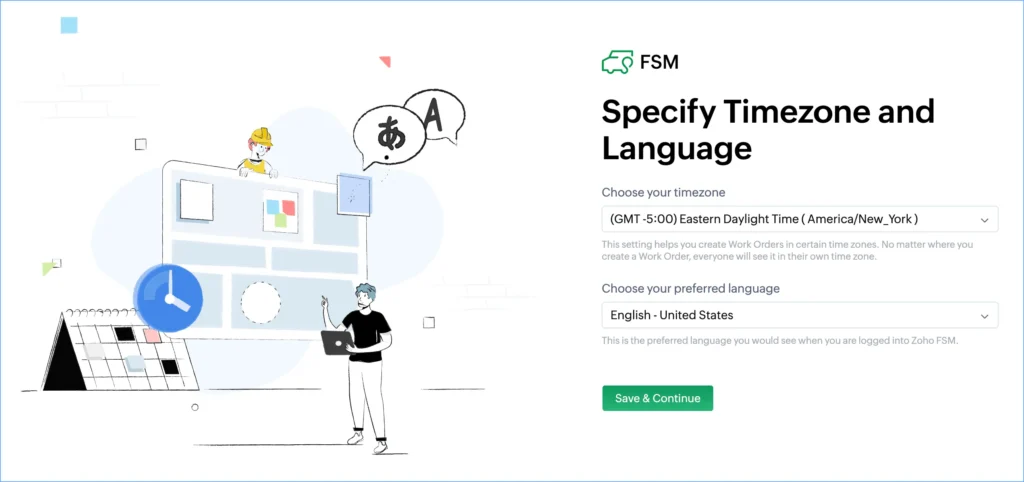
- Time Zone and Language — Affects all scheduling timestamps system-wide
- Country-Specific Tax Rate — Link to an existing Zoho Books or Zoho Invoice account (or a new one is created automatically). Set tax rates for estimates, work orders, and invoices, and specify the relevant tax authority. Adjustable later via Setup > Integrations > Billing > Tax Settings.
- Services Offered — Your initial service catalogue, which populates the Services & Parts module
Getting these foundations right matters more than most teams realise. A misconfigured business hours setting, for example, causes scheduling errors that are time-consuming to unwind later. If you’re setting up FSM as part of a broader Zoho rollout, see our guide on Zoho Implementation Services for the recommended sequencing.
Step 2: Define Your Workforce Structure
Navigate to Setup > Workforce and configure:
- Territories — Define service areas by geography, department, or business unit. Territories control which agents are available for which appointments and are the primary routing logic in the Dispatch Console.
- Skills — Tag technicians with relevant skills (e.g., “HVAC Repair”, “Electrical Certification”, “Plumbing”). The Dispatch Console uses skills to surface the right agent for each job type.
- Users vs Crew — Add system Users (login access, full mobile app) and Crew members (schedulable but no login). Assign profiles — Field Agent, Dispatcher, Call Centre Agent — to each user based on their role.
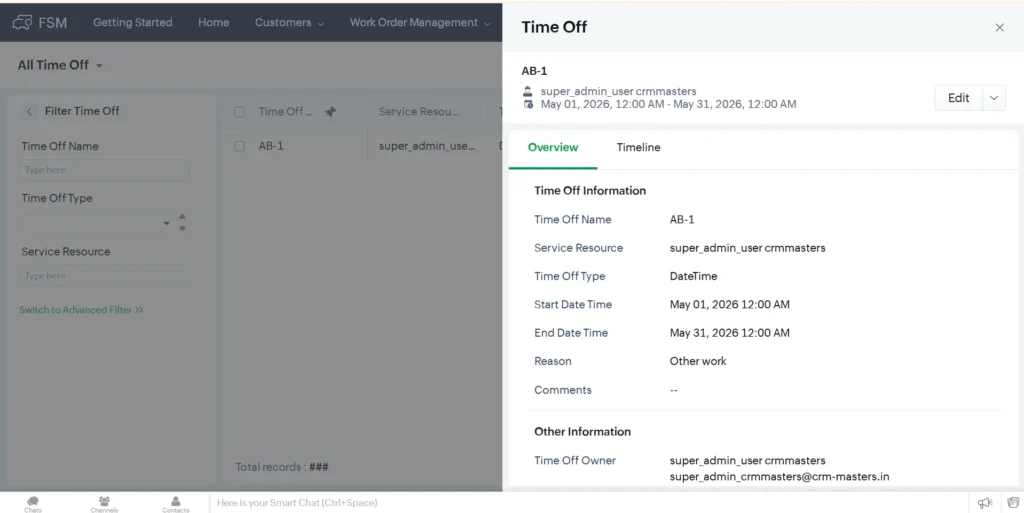
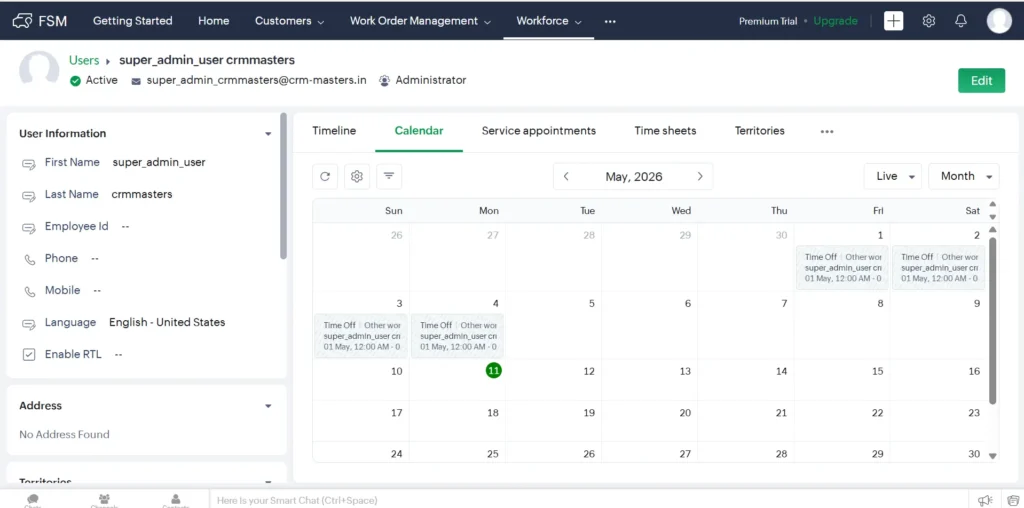
- Time-off — Record technician unavailability to prevent the Dispatch Console from scheduling conflicts.
Step 3: Build Your Services and Parts Catalogue
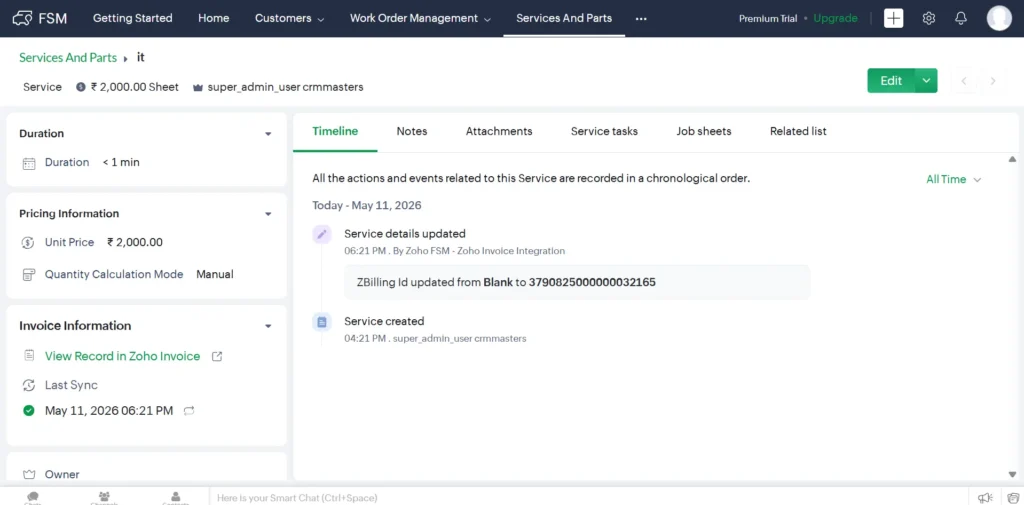
Go to the Services & Parts module and build your master catalogue. Categorise items as either Services (labour-based) or Parts (physical goods/inventory). These line items auto-populate in estimates, work orders, and invoices; the accuracy of this catalogue directly affects billing speed and invoice quality.
Step 4: Create Your First Work Order
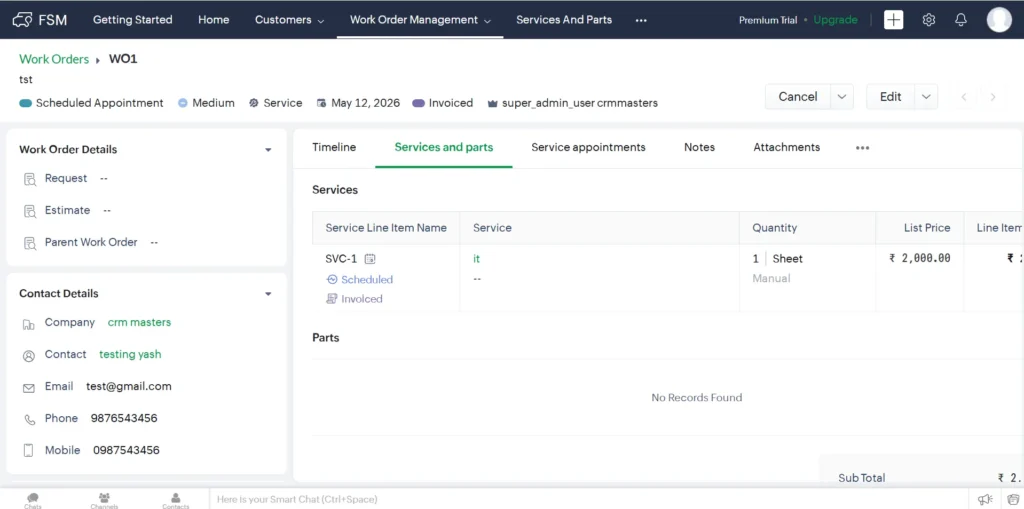
A Work Order is created in response to a Service Request. The complete workflow:
1. Log a Service Request — Manually (phone call or walk-in), via API, through an embedded web form, or through the customer self-service portal.
2. Create an Estimate (optional) — If your model requires quoting before job approval, convert the request to an Estimate. Add materials, labour, quantities, and pricing. Send to the customer via the built-in email template.
3. Convert to Work Order — Once approved (or directly, if no estimate is needed), create the Work Order. Populate priority, due date, contact, asset location, and preferred service timing.
4. Add a Service Appointment — Open the Work Order > Appointments tab > click Create Appointment. Select appointment type, assign a lead agent, and confirm the date and time slot.
Step 5: Schedule and Dispatch via the Dispatch Console
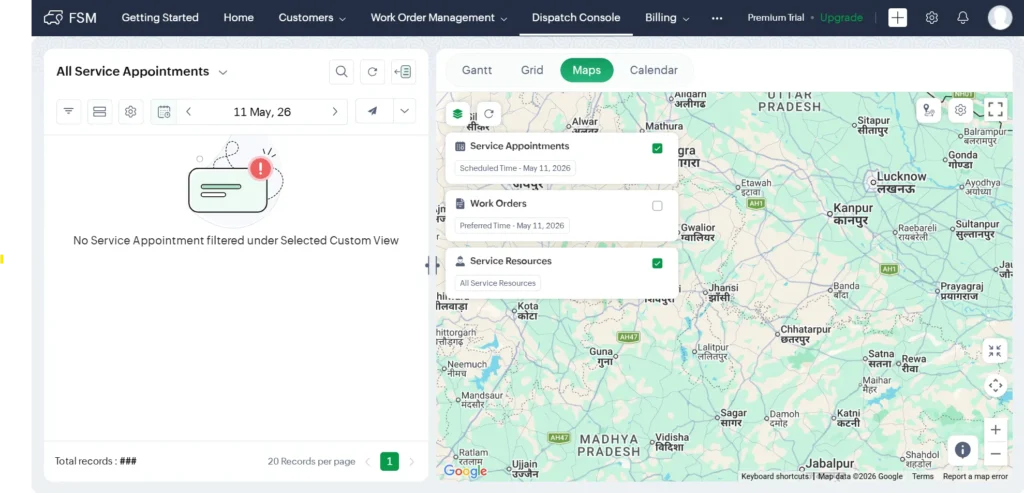
The Dispatch Console is the operational core of Zoho FSM. It offers four scheduling views:
- Gantt View — Timeline-based view of all technician schedules across single or multi-day windows
- Grid View — Tabular view of appointments by agent
- Calendar View — Day, week, or month appointment calendar
- Map View — Live location tracking of field agents and job sites simultaneously
To dispatch: open the Work Order > Appointments tab > select the appointment > click Dispatch. The lead field agent is notified instantly on the Zoho FSM Mobile App and uses it to check in when they reach the site.
Step 6: Field Execution via the Mobile App
The Zoho FSM Mobile App (iOS and Android) gives field agents everything they need on-site:
- Full appointment details and customer job history.
- GPS navigation to the service location.
- Job Sheet access — standardised checklists, on-site data entry (photos, notes, meter readings)
Parts request and inventory lookup.
- Digital customer signature collection.
- Service report generation on job completion.
- Online payment collection through the Zoho Books-linked payment gateway.
- When all associated service appointments are marked Closed, the parent Work Order automatically closes, no manual status update required.
Step 7: Invoice and Record Payment
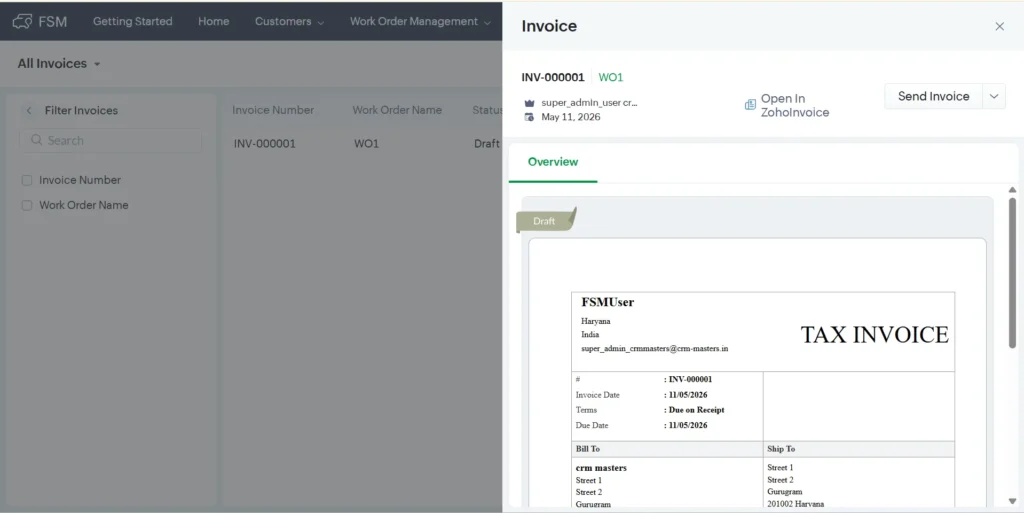
From a completed Work Order, generate an invoice directly within Zoho FSM, powered by Zoho Books or Zoho Invoice. Invoices carry your company branding, auto-populate line items from the work order, and support multiple currencies and tax jurisdictions. Send via email with an online payment link, or record offline payment (cash, cheque, card). The payment is automatically reconciled in Zoho Books.
Zoho FSM Integrations
Zoho FSM connects natively with the following — all configurable without third-party middleware:
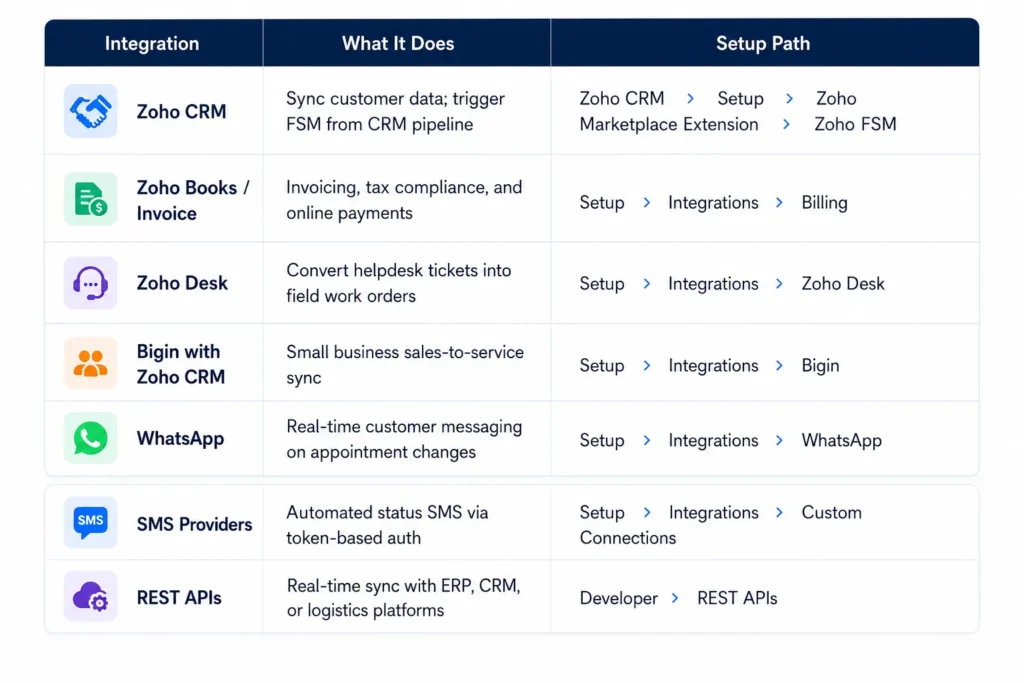
The Zoho Integration Services team at CRM Masters regularly handles FSM integrations with external ERP systems, custom-built platforms, and third-party logistics tools beyond the native Zoho stack. For an overview of what’s possible across the Zoho ecosystem, the Top Zoho Integrations guide covers the most valuable cross-platform connections businesses are deploying in 2026.
Zoho FSM Pricing
Zoho FSM uses a volume-based pricing model; you pay per service appointment created, not a flat per-user fee. This makes it cost-efficient for businesses with large field teams where not every worker needs a full user licence. A free trial is available through Zoho directly. For enterprise pricing, custom volume tiers, or bundle pricing within Zoho One, contact the CRM Masters team for a no-obligation breakdown.
Analytics and KPI Monitoring
Zoho FSM includes more than 20 built-in dashboards and reports, covering:
- First-Time Fix Rate — Percentage of jobs resolved without a return visit
- Work Orders Per Day / Per Agent — Throughput and individual productivity
- Agent Idle Time — Identifies scheduling inefficiencies and capacity gaps
- Appointment Completion Rate — SLA adherence tracking
- Revenue Per Work Order — Connects field output to financial performance
Custom reports can be built using the report builder. For businesses that need cross-functional visibility, combining FSM performance data with CRM pipeline, finance, or HR metrics, Zoho Analytics connects directly to FSM and the broader Zoho ecosystem.
Common Setup Mistakes to Avoid
Most Zoho FSM implementations that underperform share the same root causes. Based on experience across 4,000+ Zoho projects, these are the configuration decisions that matter most:
1. Skipping territory and skill setup
Without territories defined upfront, the Dispatch Console cannot route intelligently. The system assigns jobs manually, which defeats the purpose of automated dispatch.
2. Mismatched Zoho Books integration
If the tax rates, currency settings, or account mapping between FSM and Books are configured incorrectly at setup, invoices generate errors or go to the wrong accounts. Fix this in Setup > Integrations > Billing before creating any work orders.
3. Treating Crew as Users
Adding all field workers as full Users inflates costs and creates unnecessary access management overhead. Use the Crew designation for workers who only need to receive job notifications.
4. Not configuring the Services catalogue before going live
Line items added ad hoc during work order creation are inconsistent, make reporting unreliable, and slow down billing. Build the catalogue first.
5. Over-automating too early
Workflow automation in FSM is powerful, but adding too many rules before the team understands the base system creates confusion. Start with manual dispatch for the first few weeks, then layer automation once the core processes are stable.
Getting the Most from Zoho FSM
Setting up Zoho FSM correctly requires more than clicking through the onboarding wizard. The highest-impact decisions are made in Workforce configuration (territories and skills), Dispatch Console setup, and the integration architecture connecting FSM to Zoho Books and Zoho CRM. Businesses that invest time here see measurable improvements in first-time fix rates, technician utilisation, and billing cycle speed.
For organisations with complex field service structures, multiple territories, mixed workforce types, or existing Zoho CRM deployments, working with a certified implementation partner accelerates the deployment and avoids the configuration errors that take weeks to untangle later.
Still figuring out how to set up Zoho FSM?
CRM Masters Infotech is a Zoho Premium Partner with 100+ certified consultants and 4,000+ Zoho projects delivered across India, the UK, the UAE, and the USA. We handle FSM configuration, Zoho ecosystem integration, team training, and ongoing support, so your field service operations run on day one.
Frequently Asked Questions About Zoho FSM
Q1. Is Zoho FSM part of Zoho One?
Ans. Yes. Zoho FSM is included in the Zoho One suite. It can also be purchased as a standalone product under volume-based appointment pricing. For a full overview of the Zoho One stack and how FSM fits within it, see our Zoho One Implementation Guide.
Q2. Can I use Zoho FSM without Zoho Books?
Ans. Yes. If you don’t have an existing Zoho Books or Zoho Invoice account, Zoho FSM creates one automatically during onboarding. Basic invoicing is available within FSM regardless of your existing Zoho setup.
Q3. How does Zoho FSM handle recurring services?
Ans. Zoho FSM supports scheduled maintenance plans. You can create recurring Work Orders and Service Appointments, daily, weekly, monthly, or on a custom interval, for assets or customers that require periodic servicing.
Q4. What is the difference between a User and a Crew member?
Ans. Users can log in to Zoho FSM and the mobile app. Crew members can be scheduled for appointments, but have no system login access. Crew is ideal for subcontractors or field workers who need job notifications without full platform access.
Q5. Does Zoho FSM have an API?
Ans. Yes. Zoho FSM provides REST APIs for real-time work order synchronisation with third-party ERP, CRM, or logistics platforms. It also supports OAuth 2.0 for secure external connections.
Q6. Can Zoho FSM track field agent location in real time?
Ans. Yes. The Dispatch Console’s Map View shows live agent positions. The mobile app uses GPS for check-in and provides navigation to each job site.
Q7. What industries use Zoho FSM?
Ans. HVAC and refrigeration, IT infrastructure, cleaning and facilities management, medical equipment servicing, solar installation, telecommunications, and utilities, any field-based business that dispatches technicians to customer sites.
Q8. How does Zoho FSM connect to Zoho CRM?
Ans. The Zoho FSM extension for Zoho CRM is installed from the Zoho CRM Marketplace. Once connected, it syncs contact and company records bidirectionally, and helps sales reps create FSM service requests directly from CRM records, creating a clean handoff from pipeline to field service without any duplicate data entry.