

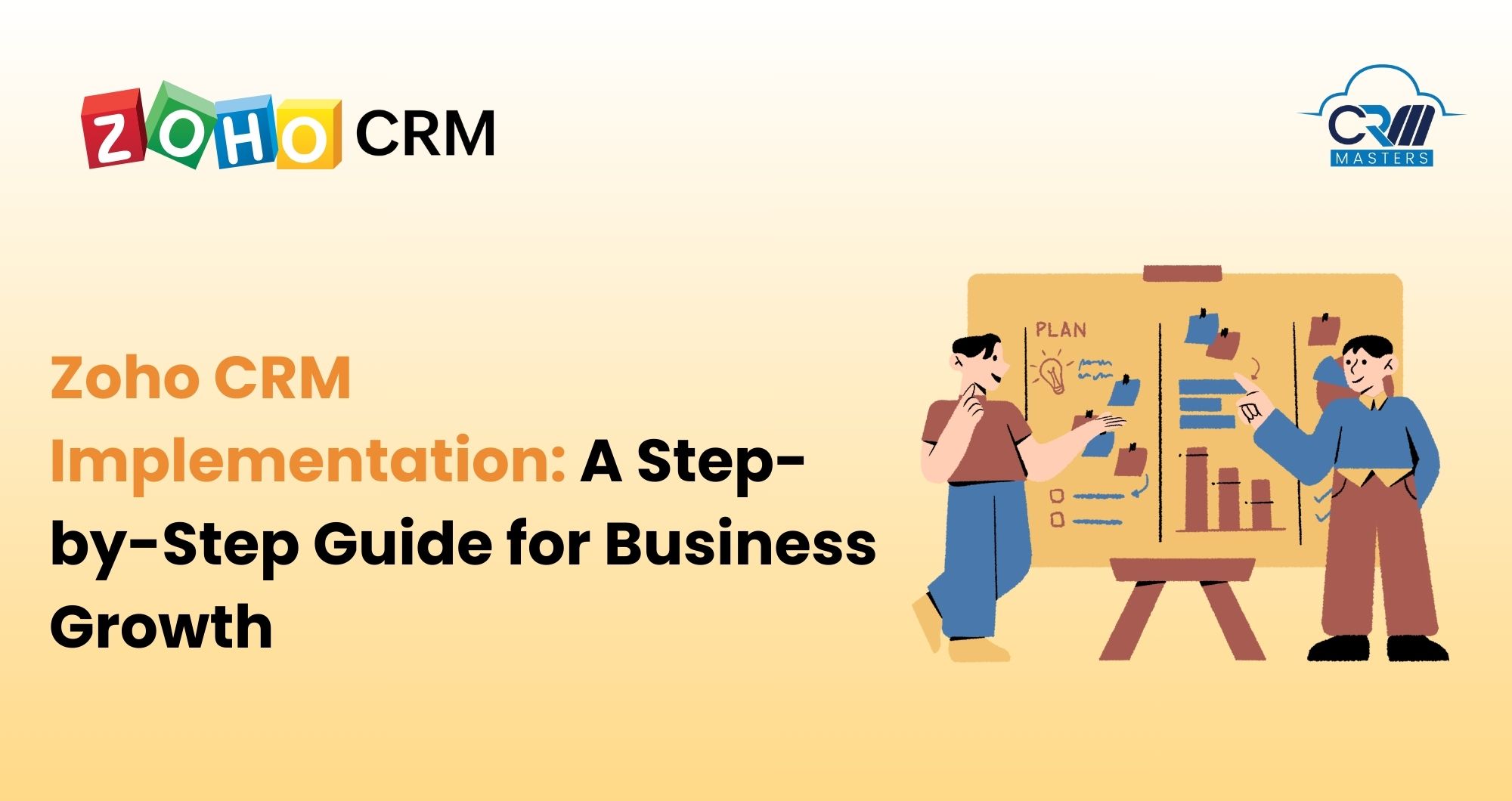
Zoho CRM Implementation: A Step-by-Step Guide for Business Growth
As businesses grow, managing leads, customers, and sales processes becomes more complex. Implementing a CRM system is no longer just a technical setup—it is a structured business project that directly affects productivity, reporting, and revenue outcomes. A well-planned Zoho CRM implementation helps teams work consistently, track opportunities clearly, and scale operations with confidence.
Zoho CRM Implementation are about fitting a tool into processes where strategies, teams, and customer engagement methods continue to shift. Across growing organizations, certain challenges appear repeatedly during CRM Implementation. Understanding these challenges early helps in planning an implementation that is practical, adaptable, and aligned with how the business operates.
This blog explains what challenges users of Zoho CRM face during implementation, the benefits of using Zoho CRM, best practices, structured processes, etc.
Why Zoho CRM Implementation Fails Without Planning
A lack of planning while implementing Zoho CRM Setup is the main cause businesses struggle. When businesses only focus on using the tool without aligning it with the business’s operations, it often sees the gaps.
Some of the reasons for poor implementation factors are mentioned below:
-
Growing Business Needs Are Not Reflected in the CRM
Sales strategies keep changing in the growing business environment. Over time, customer engagement strategies improve, sales cycles change, and new lead sources are added. The CRM may not be able to support future requirements if it is implemented only on the basis of present needs.
Without planning, the CRM structure doesn’t change as the company grows. Workarounds, manual tracking outside of the system, and a decline in confidence in CRM data result from this.
-
Data Migration Becomes Difficult and Risky
Migrating data from the current setup into the Zoho CRM is often taken lightly by the teams, and it shows later. Spreadsheets, email inboxes, and other tools may contain customer data, frequently with inconsistent formatting.
Inaccurate or missing data is imported in the absence of a clear migration plan. Users become confused as a result, and reporting accuracy is impacted.
-
No Clear Metrics to Measure Success
Many businesses implement Zoho CRM without defining how success will be measured. Teams may track activities, but leadership lacks visibility into meaningful performance indicators.
It is challenging to determine whether Zoho CRM is increasing customer engagement or sales efficiency without clear metrics. This frequently results in the assumption that the CRM is not providing value.
-
Poor User Adoption Across Teams
One of the main challenges in CRM implementations is user adoption. Users view the CRM as an additional task rather than a support system when they are unaware of how it helps them in their day-to-day work.
Incomplete data, missed updates, and inconsistent reports are the outcomes of poor adoption. Teams eventually revert to their previous practices, and the CRM is underutilized.
Zoho CRM Implementation Process
A successful Zoho CRM Implementation follows a structured and clear approach. While Zoho offers flexible tools, the team needs to adopt them well for continuous growth.
-
Planning
Implementation requires proper planning. At this point, businesses should be focused on goals rather than the CRM features and should be aware of exactly what they want the CRM to do. This includes improving lead follow-ups, increasing visibility into the sales pipeline, or developing standardized reporting for leadership, etc.
-
Analyzing
Once goals are defined, the next step is to analyze business requirements in detail. This involves confirming how sales processes currently work and identifying what needs to be supported inside the CRM. At this stage, teams should review how leads are captured, how deals move between stages, and where information is often missed or duplicated.
-
Designing
During this stage, the focus will be on summarizing the requirements into a workable CRM structure, including customization, integration, & migration. The sales stages, data fields, and user roles in particular should be reviewed against real business processes. This is not about forcing the business to work according to the CRM, but rather looking at how the CRM can be configured to support the existing business processes.
-
Validating
Validation ensures the CRM works as expected before full deployment. A test environment allows teams to check workflows, data flow, and usability without affecting live operations. Sales teams should be given access to test real scenarios such as lead conversion, deal progression, and reporting. Their feedback is critical at this stage. Validation helps identify gaps, usability issues, and incorrect assumptions early, when changes are easier to make.
-
Deploying
At this stage, the CRM is made available to the wider team, and training plays a key role during deployment. Clear documentation, role-based training materials, and ongoing support help users adapt smoothly. Teams should be enabled to share feedback and highlight pain points as they begin using the system. Implementation does not end at deployment. Observing usage patterns and identifying areas for improvement ensures the CRM continues to support business growth over time.
Common Zoho CRM Implementation Challenges
Even going with clear and structured planning, businesses may face challenges. These issues generally come when the new system is not configured, designed, or introduced to users properly.
-
Over Customization
Businesses can customize Zoho CRM according to their business requirements and future goals, but here’s the catch. Sometimes, too many layouts, fields, workflows, or modules can confuse users and slow down the performance & maintenance. The key is balancing; do not over-customize your Zoho CRM, ensure changes improve efficiency rather than creating a cluttered interface.
-
Poor Data Structure
Poor data structure includes unclear modules, fields, relationships, & workflows, which makes CRM cluttered. This leads to difficulty in finding the right information, inaccurate reports, duplicate data, or inconsistent records. During the Implementation, defining standard formats & clear data fields make sure the CRM stays reliable & easy to use.
-
Weak Automation Logic
Automation is meant to reduce manual work, but poorly designed workflows often create more problems than they solve. Automations that trigger at the wrong time or apply to the wrong records confuse users and disrupt processes. Weak automation logic can result in unnecessary notifications, missed follow-ups, incorrect task assignments, etc. Effective automation should support existing processes, not control them; each workflow must have a clear purpose, and this is why workflows should be planned carefully during implementation.
-
Low User Adoption
A CRM is only useful if people use it. Low adoption usually happens when users do not understand the system or feel it adds extra work. Common issues related to low user adoption includes lack of proper training, no clear explanation of how CRM works daily, overly complex layouts, etc.
Zoho CRM Automation and Workflow Design
Automation in Zoho CRM Setup is most effective when it supports how sales teams already work, rather than forcing new behaviour through rules. A well-designed workflow system reduces manual effort, improves consistency, and ensures critical actions are never missed.
-
Creating Workflows Based on Real Sales Activities
The sales funnel involves a number of repeatable activities, such as assigning leads, creating a follow-through task, status updates, and internal alerts. These activities can be automated using workflows inside the CRM.
For example, a task can be created when a lead is assigned, or a reminder can be sent when a deal stays inactive for too long. This helps teams stay organized without depending on manual tracking.
-
Deciding Where Automation Adds Value
Not every activity in the CRM benefits from automation. Zoho CRM workflows are best applied to actions that follow clear rules and do not require manual judgment. These typically include:
- Lead assignment based on predefined criteria
- Task creation after stage or status changes
- Notifications for inactivity or missed timelines
- Standard field updates driven by specific actions
By limiting automation to predictable scenarios, businesses avoid unnecessary complexity and keep the CRM flexible for real-world sales situations.
-
Avoiding Over-Automation
One of the most common issues in CRM automation is building too many workflows without a clear structure. When several rules interact, there could be unexpected changes, duplicate work, or confusing system behavior. Regular reviews help identify workflows that are no longer relevant as sales processes evolve.
A structured workflow design ensures:
- Each rule serves a clear purpose.
- Conditions do not conflict with one another.
- Automation supports users instead of restricting them.
-
Monitoring Workflow Performance and Improvements
Automation does not end once workflows are activated. With Zoho CRM, you can monitor the workflows execution. This ensures workflows are updated along with business needs.
By reviewing workflow activity and outcomes, businesses can:
- Spot bottlenecks in the sales process.
- Identify rules that are underperforming.
- Adjust automation based on actual usage patterns.
-
Extending Automation Beyond the CRM
Zoho CRM workflows are not limited to the built-in activities. By leveraging the function of custom functions, there are automated activities possible in other connected applications like email, accounting, and support software. This allows businesses to build end-to-end processes that flow across departments.
Zoho CRM Integration with Other Systems
To get the most out of the CRM Implementation, businesses should integrate it with other tools that they are already using to create a unified experience for their team.
Zoho CRM can be integrated with different system & tools, some of which are mentioned below:
- Marketing: You can integrate Zoho CRM with marketing tools & other Zoho Products to track email marketing campaigns, capture leads from social media sources directly into CRM, immediate follow-up, etc.
- Communication: Integrate communication & collaboration tools like Google Workspace, Zoho Cliq, Slack, Zoho Voice, Zoom, etc, to get the unified view of customer & internal team interaction directly into the CRM.
- Finance & Operations: Integrate Zoho CRM with accounting & project management tools to sync customer data, to make sure the finance team is aligned, and to share updates to sales & project teams.
- Data & Analytics: Zoho CRM can be integrated with tools like Zoho Analytics & other third-party tools to create rich, interactive reports and dashboards for well-informed decision-making.
- Customer Service & Support: Zoho CRM integration with customer support tools to connect sales and service data. Zoho Integration Services helps the team see the customer journey, purchase history, complaints, resolutions, etc, which helps in assisting them better.
Zoho CRM Implementation Partner vs Internal Team
An internal team can manage implementation if there are fewer requirements, simpler processes, and the CRM is only used for basic lead and deal management. Internal teams know the business, but they might not have experience with Zoho CRM architecture, automation, and integration, which can cause delays or rework.
In cases where the CRM system has to handle multiple teams or complex workflows, or where growth is expected in the future, a Zoho Implementation Partner can be very helpful. A partner can bring structured experience to the table, and the system can be designed for scalability. From a risk management perspective, partner-delivered implementations are more stable and easier to scale.
Evaluate Your Zoho CRM Implementation Plan
If you are planning a new CRM rollout or reviewing an existing setup, evaluating your implementation approach early can prevent costly rework later. A structured assessment helps identify gaps in process design, automation, and data flow so your CRM supports growth effectively.
You can explore expert guidance from CRM Masters if you need structured implementation support.
FAQ
Q1. How long does Zoho CRM Implementation take?
Ans. The project timeline totally depends upon the complexity, customization, and advanced features of implementation. A simple project may take a few weeks, while working on the advanced customization and functionality can take up to several months.
Q2. Can Zoho CRM be implemented without a partner?
Ans. Yes, for basic, limited, or well-defined requirements, can be done without a partner. However, complex processes, automation, system stability, advanced functionality, etc often require experienced guidance to help avoid design mistakes and reduce the need for rework later.
Q3. What industries use Zoho CRM?
Ans. Zoho CRM is used by a wide range of industries such as manufacturing, retail, ecommerce, technology, service-based, real estate, etc. This tool offers flexibility, which allows it to adapt to different industry needs.
Q4. Is Zoho CRM suitable for a growing business?
Ans. Yes, Zoho CRM works well for growing businesses when implemented with a structured and flexible approach. It supports evolving sales processes, expanding teams, and increasing data volume.