

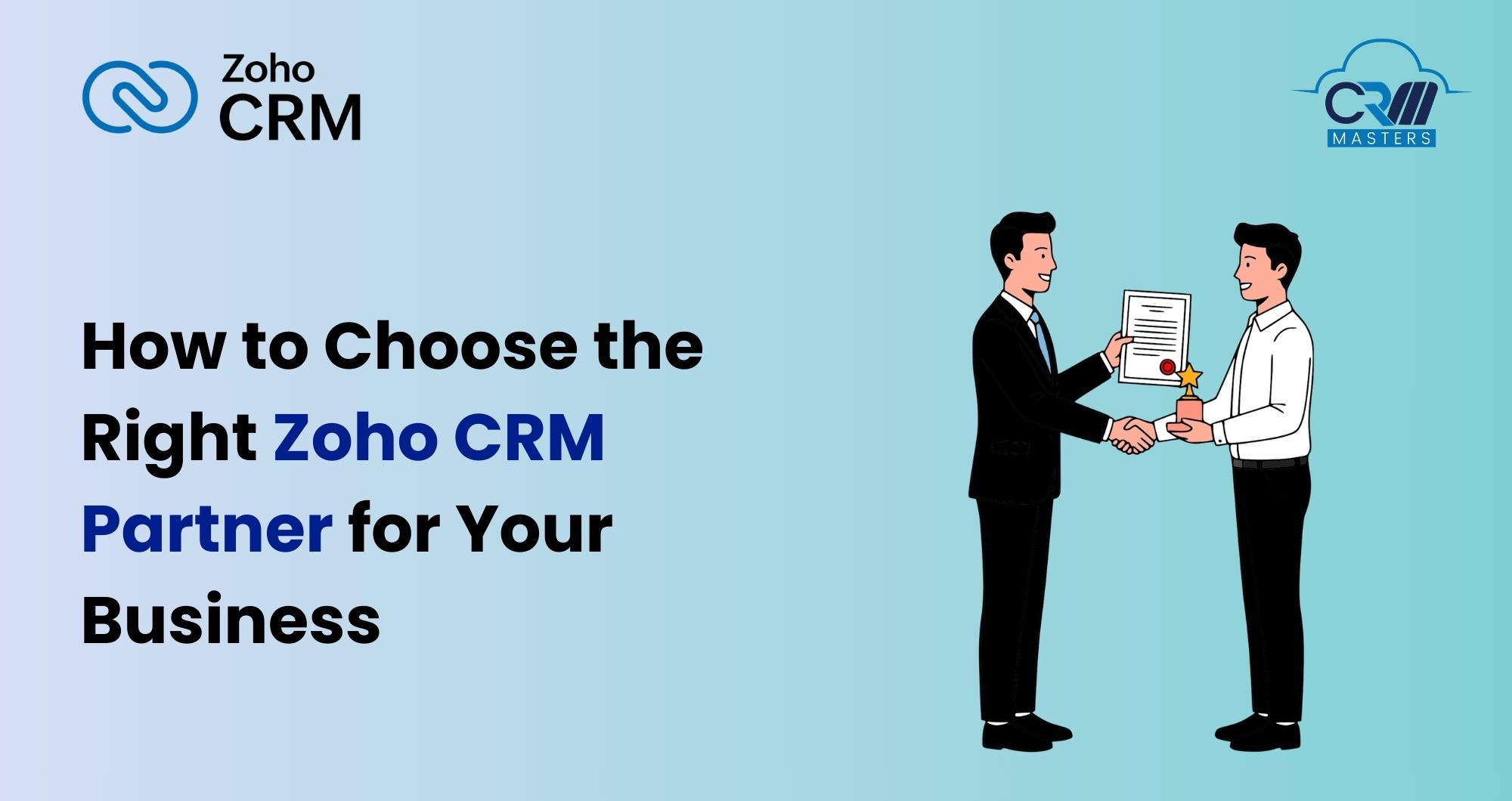
How to Choose the Right Zoho CRM Partner for Your Business
Implementing a CRM system is rarely just a technology upgrade. It is an operational shift that influences sales execution, marketing alignment, reporting accuracy, and long-term scalability. Yet many CRM initiatives underperform — not because of the software itself, but because of how implementation decisions are made.
Selecting the right Zoho Crm Partner is therefore not a vendor comparison exercise. It is a strategic decision that affects efficiency, adoption, governance, and business growth.
This guide provides an educational and decision-support framework to help organizations evaluate their options carefully and reduce implementation risks.
What Does a Zoho CRM Partner Actually Do?
Many CRM implementations fail for reasons unrelated to Zoho’s platform capabilities. In most cases, the software itself is not the limitation — the breakdown happens during planning, execution, or adoption.
Zoho CRM is a flexible platform with automation, reporting, customization, and integration capabilities. However, flexibility alone does not guarantee success. When CRM is implemented without strategic clarity, it often becomes a complex database rather than a decision-support system.
Implementation challenges typically arise from:
- Unclear business objectives
- Poorly defined sales or service processes
- Inadequate discovery before configuration
- Excessive customization
- Lack of governance planning
- No structured adoption strategy
In many organizations, CRM is treated as a technical setup task rather than a business transformation initiative. Modules are configured quickly, automation is added, dashboards are built — but core questions remain unanswered:
- What problem is CRM solving?
- How should leads move through the pipeline?
- What data is truly required for reporting?
- Who owns data accuracy?
- How will success be measured?
Without answering these foundational questions, even the most feature-rich system will struggle to deliver value.
This is where the role of a zoho crm partner becomes critical. The difference between a functional CRM and a strategic CRM lies in how well business processes are translated into system architecture.
Choosing the right partner is therefore not about technical execution alone. It influences:
- Implementation efficiency
- Process clarity
- Data reliability
- User adoption
- Long-term scalability
When viewed strategically, selecting a partner is less about purchasing services and more about reducing operational risk.
A CRM system should support growth, visibility, and structured decision-making. The right partner ensures that the platform is designed with those outcomes in mind from the beginning.
Types of Zoho Partners
Understanding partner categories helps avoid mismatched expectations. Not all partners offer the same scope of services.
Zoho Implementation Partner
A Zoho Implementation Partner focuses primarily on system setup and technical configuration. Their role is centered on translating defined requirements into a functional CRM environment.
- Module configuration
- Workflow automation
- User role design
- Data migration
- Dashboard creation
Their expertise lies in technical execution. However, they may not always provide deep process consulting unless specifically structured to do so.
Zoho Consulting Partner
A Zoho Consulting Partner works at the strategic level before implementation begins. Their primary focus is not immediate configuration, but defining how CRM should support business objectives.
Their focus includes:
- Process analysis
- CRM strategy alignment
- Requirement documentation
- Roadmap planning
- Governance design
They help clarify what should be built before discussing how to configure it.
Integration Partner
A Zoho Integration Partner focuses on connecting Zoho CRM with other business-critical systems to ensure seamless data flow across departments.
- API connections
- ERP integration
- Accounting system synchronization
- Marketing automation linking
- Data flow architecture
Integration partners ensure that CRM does not operate in isolation. Instead, it becomes part of a connected ecosystem where sales, finance, marketing, and operations share consistent and reliable data.
Support Partner
Support-focused partners provide ongoing assistance after implementation is complete. Their role is to maintain system stability, optimize performance, and ensure the CRM continues to align with evolving business needs.
- Ongoing troubleshooting
- CRM optimization
- System updates
- User training refreshers
- Performance reviews
Important clarification:
Not every Zoho CRM Partner offers consulting, integration, implementation, and support under one structure. During Zoho Partner Selection, confirm the exact scope of services provided.
Key Criteria to Evaluate a Zoho Partner
Selecting the right partner requires a structured evaluation. Below are core decision lenses.
1. Industry Understanding
Industry context influences far more than basic CRM configuration. It shapes how data is structured, how pipelines are defined, and how performance is measured.
- Sales cycle length
- Compliance needs
- Reporting requirements
- Lead qualification processes
A partner unfamiliar with your industry may rely on generic templates, leading to unnecessary customization.
An experienced Zoho CRM Partner translates industry knowledge into a practical CRM structure.
2. Process-First Approach
CRM configuration should follow process clarity, not the other way around. The system must reflect how your business actually operates, rather than forcing teams to adapt to a pre-built template.
Evaluate whether the partner:
- Conducts structured discovery sessions
- Maps current workflows
- Identifies bottlenecks
- Defines measurable KPIs
A strong zoho implementation partner configures modules after understanding business flow — not before.
3. Integration Capability
Modern systems rarely operate independently. CRM platforms must connect seamlessly with finance, marketing, operations, and support systems to ensure consistent data flow across the organization.
Assess whether the partner can:
- Connect CRM with ERP
- Sync accounting platforms
- Integrate marketing automation
- Ensure data consistency
Integration capability becomes especially critical as companies scale. What works manually for a small team quickly becomes inefficient for a growing organization.
A capable zoho crm partner evaluates integration needs early in the discovery phase rather than treating them as an afterthought.
4. Customization Philosophy
Customization is powerful but risky if overused. While Zoho CRM allows extensive flexibility through custom fields, modules, functions, and automation scripts, excessive customization can create long-term complexity that outweighs short-term convenience.
Ask:
- Do they recommend native features first?
- Is customization aligned with business value?
- How will updates affect custom scripts?
- A mature zoho crm partner balances flexibility with maintainability.
5. Adoption Strategy
CRM success depends on consistent usage. Even the most technically well-designed system fails if teams do not use it correctly and consistently. Adoption is not automatic after implementation — it requires planning, communication, training, and ongoing reinforcement.
Evaluate whether the partner plans:
- Role-based training
- User onboarding sessions
- Adoption metrics
- Documentation support
A technically strong system without user adoption delivers limited business value.
6. Long-Term Scalability
Scalability considerations include system architecture, data structure, governance controls, integration planning, and the ability to adapt as the business grows.
During zoho partner selection, assess how the system will function two to three years ahead — not just at launch.
Warning Signs of the Wrong Partner
Mistake prevention is critical when evaluating CRM support.
Below are red flags to monitor:
1. Feature-Focused Discussions
If conversations center on dashboards and automation without process discovery, strategic alignment may be lacking.
2. No Discovery Phase
Skipping structured requirement workshops often results in rework.
3. Over-Promising Timelines
CRM alignment requires careful planning. Unrealistic timelines often indicate superficial configuration.
4. Customization-Heavy Mindset
Excessive scripting and field creation create upgrade challenges and long-term maintenance complexity.
5. No Adoption Planning
If training and change management are not addressed, implementation risks increase.
A capable Zoho CRM Partner approaches CRM as an operational framework, not just a technical deployment.
Partner vs Freelancer vs Internal Team
Organizations evaluating CRM implementation typically consider three options: working with a partner, hiring a freelancer, or relying on an internal team.
Each model differs in terms of strategic depth, scalability, risk exposure, and long-term governance. The right choice depends on business complexity, growth plans, and internal capability.
The comparison below provides a structured decision framework to help evaluate these differences objectively.
| Criteria | Partner | Freelancer | Internal Team | |
| Strategy Depth | Multi-disciplinary expertise | Limited to individual experience | Depends on internal maturity | |
| Scalability | High – structured governance | Low – bandwidth limitations | Moderate | |
| Speed | Structured timeline | Often fast initially | Slower due to competing priorities | |
| Risk | Shared accountability | High dependency risk | Internal accountability risk | |
| Governance | Defined processes | Informal structure | Organization-defined | |
| Long-Term Support | Ongoing models available | Availability dependent | Dependent on employee retention |
Complex CRM environments typically benefit from structured governance associated with formal partner engagement.
Real Example Scenario
Consider a growing SaaS company implementing Zoho CRM.
Initial Phase
The company selected a technically strong partner focused heavily on customization.
The resulting system included:
- Complex automation
- Multiple overlapping modules
- Highly customized workflows
Consequences:
- User confusion
- Reporting inconsistencies
- High maintenance effort
- Low adoption rates
Strategic Realignment
The company later engaged a different zoho crm partner with a process-first philosophy.
Key changes:
- Simplified pipeline stages
- Removal of redundant fields
- Reduced unnecessary automation
- Standardized reporting dashboards
Outcomes:
- Improved adoption
- Clearer reporting
- Easier system maintenance
- Better managerial visibility
The difference was not the platform — it was the implementation strategy.
When Should You Work with a Zoho CRM Partner?
Businesses typically benefit from structured partner support when:
- CRM is replacing spreadsheets or legacy systems
- Sales cycles involve multiple teams
- Reporting accuracy is critical for leadership decisions
- Integrations with finance, marketing, or support tools are required
- Growth demands process standardization
Questions to Ask Before Hiring
Before finalizing engagement, consider asking:
- What discovery process do you follow?
- How do you approach integrations?
- How do you plan user adoption?
- How do you manage future scalability?
- What governance model do you recommend?
- How do you evaluate long-term optimization?
These questions help identify depth beyond configuration capability.
A structured Zoho Consulting Partner should be able to articulate roadmap planning clearly before discussing technical setup.
Benefits of Working with the Right Partner
When CRM is implemented strategically, the impact extends beyond system configuration. A well-structured implementation influences how teams collaborate, how decisions are made, and how performance is measured across the organization.
Many organizations align their implementation approach with structured Zoho consulting services to ensure the CRM supports long-term business goals.
The value of working with the right partner lies not in adding more features, but in creating clarity — clarity in processes, data ownership, reporting standards, and long-term governance.
When CRM is implemented strategically, organizations often experience:
- Reduced operational friction
- Improved reporting clarity
- Stronger sales process alignment
- Scalable architecture
- Controlled customization
- Sustainable Growth
A competent Zoho CRM Partner ensures that CRM becomes a decision-support system rather than just a data repository.
Conclusion
CRM implementation is not merely a technical execution. It is an operational architecture.
A thoughtful approach to selecting the right Zoho CRM Partner ensures clarity, scalability, and sustainable adoption. When approached strategically, Zoho CRM becomes a structured growth enabler rather than a complex administrative tool.
FAQs
Q1. How do I choose a Zoho CRM partner?
Ans. Focus on process clarity, discovery methodology, industry understanding, and governance planning during zoho partner selection.
Q2. What is the difference between a consultant and a partner?
Ans. A Zoho Consulting Partner emphasizes strategic planning and roadmap development, while a Zoho implementation partner focuses on technical configuration and deployment.
Q3. Do small businesses need Zoho partners?
Ans. Small businesses with simple workflows may configure basic CRM internally. However, growth-focused organizations often benefit from structured partner guidance.
Q4. How to evaluate Zoho partner experience?
Ans. Evaluate:
- Discovery framework
- Integration capability
- Customization philosophy
- Adoption strategy
- Industry relevance
Experience is reflected in structured thinking rather than feature demonstrations.
Q5. Can I change partners later?
Ans. Yes. CRM ownership remains with the organization. However, transitions may require audits and restructuring depending on system complexity.
Q6. Is partner support ongoing?
Ans. Support models vary. Clarify scope, response time, and optimization plans before engagement.
Q7. What should a Zoho CRM partner not do?
Ans. A Zoho CRM partner should not rush into configuration without understanding business processes first. Skipping discovery, recommending excessive customization, or focusing only on features instead of outcomes can create long-term complexity. The right partner prioritizes process clarity, scalability, and user adoption rather than quick technical setup.
Q8. How long should Zoho CRM partner selection take?
Ans. Zoho CRM partner selection should typically take a few weeks, depending on business complexity. Organizations should allow enough time for discovery discussions, evaluation of approach, and alignment on long-term goals. Rushed decisions often lead to mismatched expectations and implementation challenges later.