



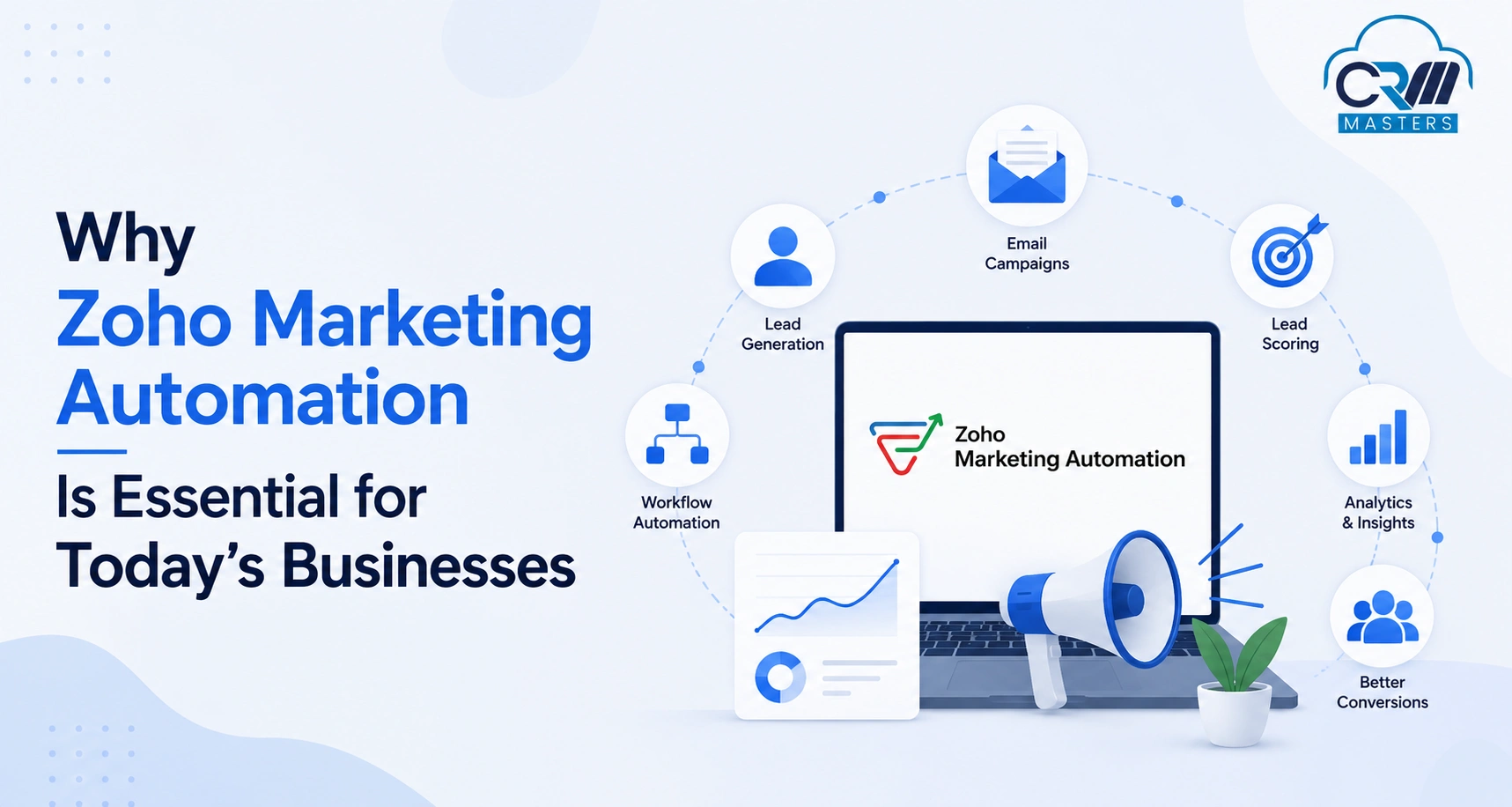
Why Zoho Marketing Automation Is Essential for Today’s Businesses
Marketing teams today manage leads across websites, landing pages, email, SMS, WhatsApp, social media, and other digital channels. As the number of campaigns and customer interactions grows, managing everything manually becomes difficult. This is where Zoho Marketing Automation comes in. Instead of treating every lead the same way, businesses can use engagement and behavior to guide their marketing and sales activities.
In this guide, we will look at what Zoho Marketing Automation is, how its lead management process works, its major features, personalization capabilities, marketing automation strategies, and how it compares with broader solutions such as Zoho Marketing Plus.
🔑 Key Takeaways
- Multichannel lead management: Zoho Marketing Automation helps businesses attract, nurture, score, and qualify leads across email, SMS, WhatsApp, social media, and website channels.
- Five-stage process: Attract prospects, nurture with relevant content, track engagement, identify sales-ready leads, and measure campaign performance.
- Core features: Multichannel lead nurturing, journey builder workflows, lead scoring, and behavior-based personalization.
- Smart lead scoring: B2B companies may prioritize demo requests and pricing page visits, while ecommerce businesses focus on cart activity and product views.
- Real personalization: Goes beyond using a first name, it relies on customer interests, engagement history, and buying journey stage.
- Choosing the right fit: Zoho Marketing Automation suits lead nurturing and scoring needs, while Zoho Marketing Plus fits broader marketing operations.
- Implementation matters: Success depends on clearly defining the lead journey, audience segments, scoring rules, and sales handoff before building workflows.
What Is Zoho Marketing Automation?
Zoho Marketing Automation is a multichannel marketing automation platform that helps businesses generate, nurture, score, and qualify leads through automated marketing campaigns and workflows.
It brings several parts of the marketing process into a connected system. Depending on the campaign and setup, businesses can use channels such as:
- SMS
- Social media
- Website forms and landing pages
The main purpose is not simply to send more messages. Marketing automation helps businesses send more relevant communication based on where a prospect is in their journey and how they interact with the business.
For example, a person who downloads a product brochure may receive a follow-up email. Someone who repeatedly engages with product-related content may receive a higher lead score. Once a lead shows sufficient interest, the sales team can focus on that prospect.
This creates a more structured process from lead generation to sales readiness.
How Does Zoho Marketing Automation Work?
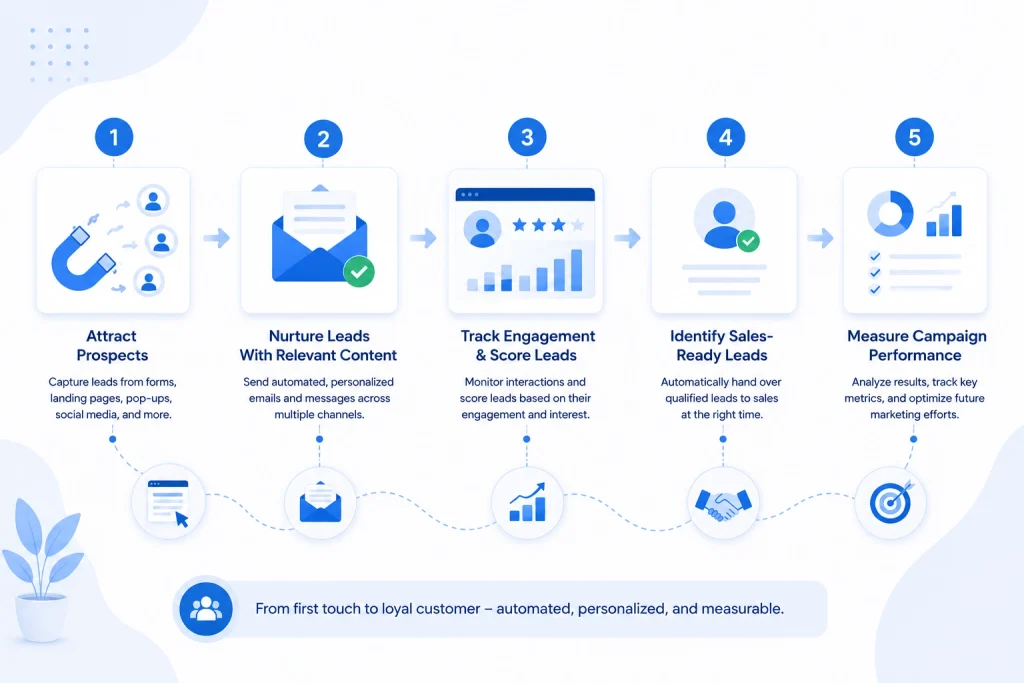
A typical marketing automation process can be divided into five stages.
Step 1: Attract Prospects
The process starts by bringing potential customers into your marketing database. Businesses can capture prospects through:
- Sign-up forms
- Pop-ups
- Landing pages
- Social media campaigns
- Website interactions
For example, a B2B software company may offer a downloadable industry report. Visitors submit their contact information to access it and become marketing leads.
Step 2: Nurture Leads With Relevant Content
Not every person who fills out a form is ready to speak with sales. Marketing automation allows businesses to continue engaging these prospects through automated communication. The communication can be delivered through different channels based on the campaign strategy. The goal is to gradually move a prospect forward rather than expecting an immediate purchase. A lead nurturing journey may include:
- A welcome email after form submission
- Educational content related to the lead’s interest
- A reminder or follow-up message
- A product-related communication
- A sales handoff when the lead shows strong intent
Step 3: Track Engagement and Score Leads
Lead scoring helps businesses understand which prospects are showing stronger buying intent. These interactions can help marketers identify which leads are actively engaging with the brand. Instead of giving equal attention to every contact, marketing and sales teams can prioritize leads based on engagement.
A lead may interact with:
- Emails
- Campaign links
- Website pages
- Marketing content
- Landing pages
Step 4: Identify Sales-Ready Leads
Once a prospect reaches a defined level of engagement or intent, the business can determine whether that lead should be passed to the sales team. This is important because sales representatives should ideally spend more time on qualified prospects rather than manually reviewing every new contact.
A connected marketing and sales process can make lead handoffs more structured and reduce the gap between campaign engagement and sales follow-up.
Step 5: Measure Campaign Performance
Marketing automation should not stop after messages are sent. This information can help businesses improve future campaigns and allocate marketing effort more effectively. Teams also need to understand:
- Which campaigns generated engagement
- Which content received more interaction
- Which campaigns produced qualified prospects
- Where leads dropped out of the journey
- Which marketing activities contributed to better results
Key Features of Zoho Marketing Automation
1. Multichannel Lead Nurturing
People do not interact with every business through the same channel. Some may prefer email, while others may respond better to SMS or WhatsApp communication. A multichannel approach allows marketers to build campaigns that use different communication channels throughout the customer journey.
For example:
| Customer Action | Automated Response |
|---|---|
| Downloads a guide | Welcome email |
| Does not engage | Follow-up email |
| Registers for an event | Confirmation and reminder |
| Shows strong engagement | Lead is evaluated for sales follow-up |
The important part is not using every channel for every customer. It is about selecting communication based on campaign goals, customer behavior, and consent.
2. Journey Builder and Automated Workflows
Marketing automation workflows allow businesses to define what should happen after a particular action. A workflow may include:
- A trigger
- Conditions
- Marketing actions
- Wait periods
- Branches based on engagement
Example: Webinar Registration Workflow
A simple webinar journey could work like this:
Registration → Confirmation Email → Reminder → Webinar Attendance → Follow-up Campaign
After the webinar, attendees and non-attendees can receive different communications. This is more efficient than manually separating and following up with every contact. For example:
- Attendees receive presentation resources.
- Non-attendees receive a recording or another opportunity to engage.
3. Lead Management and Lead Scoring
Marketing automation lead management involves organizing, tracking, nurturing, and qualifying leads before they are passed to sales. Lead scoring adds another layer to this process by helping businesses evaluate engagement.
For example, a lead who only opens one email may require more nurturing than someone who repeatedly visits product pages and interacts with campaign content. A lead management process can look like this:
New Lead → Segmentation → Nurturing → Engagement Tracking → Lead Scoring → Sales Qualification
The exact scoring model should depend on the business. A B2B company selling enterprise software may give more importance to actions such as:
- Visiting pricing or solution pages
- Requesting a demo
- Downloading technical documents
- Attending a webinar
An ecommerce business may focus more on:
- Product views
- Cart activity
- Previous purchases
- Repeat website visits
This is why lead scoring should be connected to the actual buying journey instead of using the same model for every business.
4. Personalization in Marketing Automation
Personalization is one of the most important parts of modern marketing automation. However, personalization is more than adding a customer’s first name to an email. A business can make communication more relevant using information such as:
- Customer interests
- Campaign engagement
- Website behavior
- Previous purchases
- Stage in the customer journey
Example
Imagine an ecommerce customer who purchases a laptop. Instead of sending unrelated product promotions, the business could create a follow-up journey around:
- Accessories
- Product support
- Extended services
- Related products
Similarly, a B2B company can send different content to a new prospect and an existing customer. Effective personalization depends on having useful customer data and a clear segmentation strategy.
Email Marketing Steps With Zoho Marketing Automation
Email remains an important channel for lead nurturing and customer communication. However, effective email marketing requires more than creating and sending a campaign. A basic email marketing process can include the following steps.
1. Define the Campaign Goal
Start by identifying what the campaign should achieve. Examples include:
- Lead generation
- Event registration
- Product education
- Customer retention
- Re-engagement
2. Segment the Audience
Avoid sending the same email to everyone. Contacts can be grouped based on factors such as:
- Interest
- Engagement
- Customer status
- Previous interactions
- Stage in the buying journey
3. Create Relevant Content
The content should match the recipient’s situation and the campaign objective. For example, a new lead may need educational content, while an existing customer may be more interested in product updates.
4. Automate Follow-Ups
Follow-up actions can be based on engagement. For example:
- Opened the email → Send the next relevant message.
- Did not engage → Send a follow-up after a defined period.
- Clicked a product link → Move the contact into a product-focused journey.
5. Measure and Improve
Campaign data can help marketers understand engagement and identify areas for improvement. Over time, businesses can refine:
- Audience segments
- Content
- Campaign timing
- Customer journeys
Marketing Automation Strategies and Benefits
Marketing automation works best when it is connected to a clear business strategy.
1. Lead Nurturing Strategy
Create campaigns for leads who are interested but not yet ready to buy. Focus on helpful content rather than immediately pushing a sales message.
2. Behavioral Marketing Strategy
Use customer actions to guide the next communication. For example, a visitor who downloads a guide about CRM implementation may be interested in implementation-related content.
3. Customer Retention Strategy
Marketing automation is not only for new leads. Existing customers can receive:
- Product updates
- Educational content
- Follow-up communication
- Relevant offers
4. Ecommerce Follow-Up Strategy
Ecommerce businesses can build automated communication around customer actions. For example:
Product Purchase → Thank You Message → Product Follow-Up → Related Offer
Marketing automation can also support follow-up communication when customers leave a purchase unfinished.
5. Sales and Marketing Alignment Strategy
Marketing teams generate and nurture leads, while sales teams focus on qualified opportunities. Lead scoring and engagement tracking can help create a clearer handoff between the two teams.
Benefits of Zoho Marketing Automation
1. Saves Time on Repetitive Work: Automated workflows can reduce the need to manually send routine follow-ups and manage every stage of a campaign individually.
2. Creates More Consistent Lead Nurturing: A defined workflow ensures that leads continue receiving relevant communication based on the campaign strategy.
3. Supports Personalized Communication: Segmentation and behavioral targeting can help businesses move beyond one-size-fits-all campaigns.
4. Helps Prioritize Lead Intent: Lead engagement and scoring can help teams identify prospects that need more attention.
5. Improves Marketing Visibility: Campaign reporting can help businesses understand which activities and content are generating engagement and qualified prospects.
6. Supports Marketing and Sales Alignment: When marketing engagement and lead qualification are connected to sales processes, lead handoffs can become more structured.
Marketing Automation Platforms and Tools: What Should Businesses Look For?
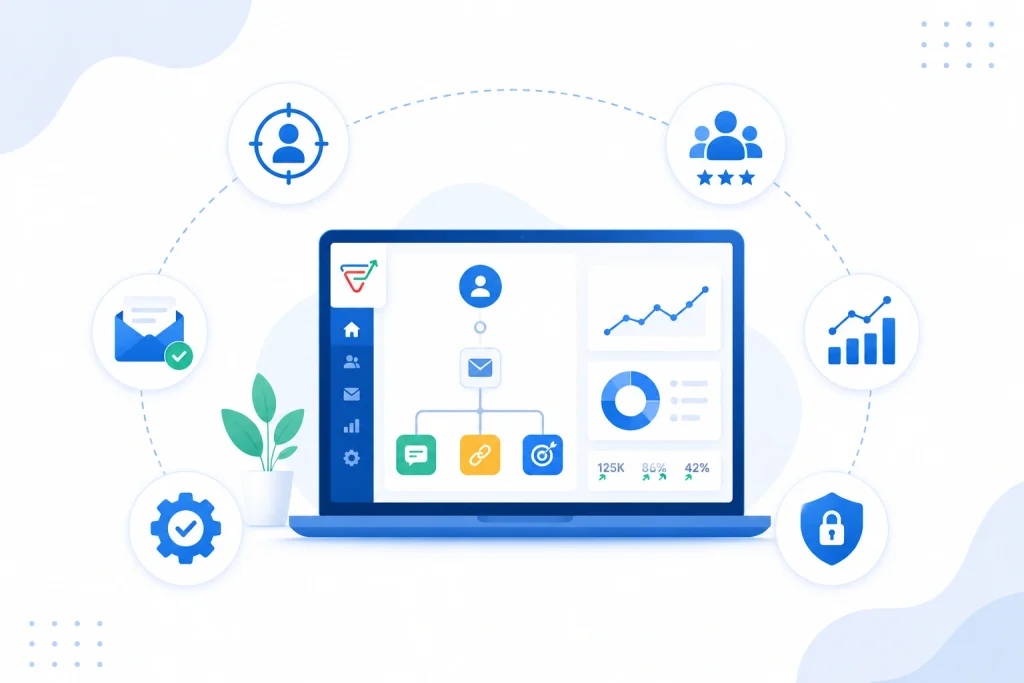
There are many marketing automation platforms available today. Choosing one should depend on business requirements rather than simply selecting the platform with the longest feature list.
When evaluating marketing automation tools, consider the following:
| Area | Questions to Ask |
|---|---|
| Lead generation | Can the platform capture and organize leads effectively? |
| Automation | Can you build workflows based on customer actions? |
| Channels | Does it support the communication channels relevant to your audience? |
| Personalization | Can campaigns be segmented based on meaningful customer data? |
| Lead scoring | Can you identify higher-intent prospects? |
| Reporting | Can you understand campaign and lead performance? |
| Integrations | Can the platform connect with your CRM and other business systems? |
| Privacy | Does it provide features that support consent and privacy management? |
The best tool depends on the existing technology stack and the level of integration a business needs. For organizations already using Zoho applications, Zoho Marketing Automation may be evaluated as part of a wider connected business ecosystem.
Zoho Marketing Automation vs Zoho Marketing Plus
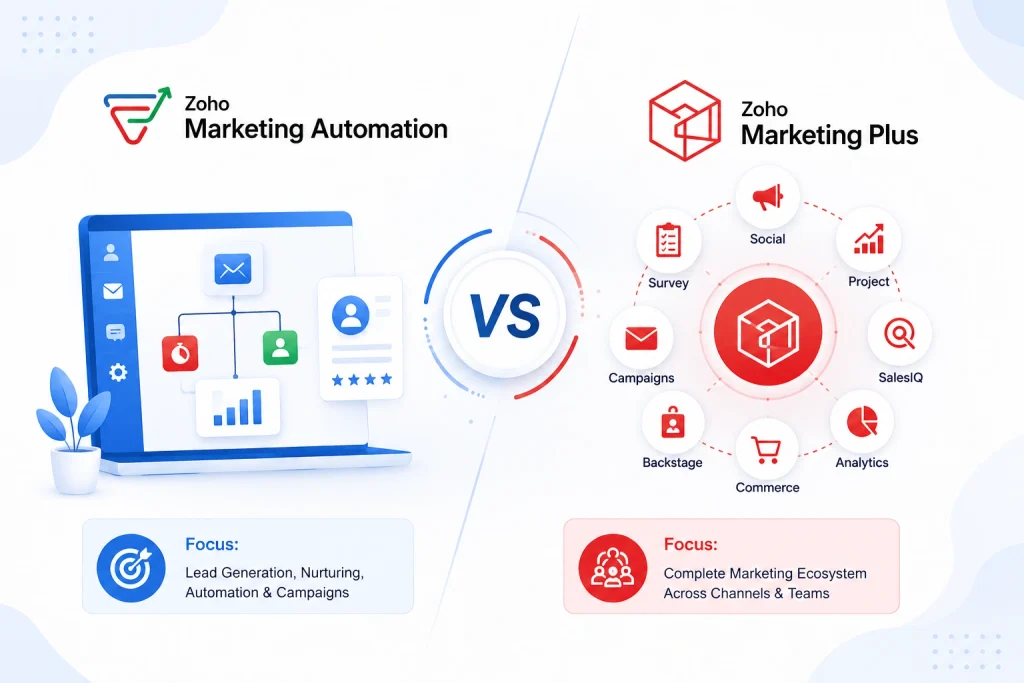
A common question is: How does Zoho Marketing Plus compare to other marketing automation tools, and how does it differ from Zoho Marketing Automation?
The main difference is in their broader purpose.
Zoho Marketing Automation focuses specifically on marketing automation, lead nurturing, behavioral targeting, and lead qualification.
Zoho Marketing Plus is positioned as a broader marketing technology solution that brings multiple marketing activities and tools together.
A business should therefore start with its requirements.
| Requirement | Better Starting Point to Evaluate |
|---|---|
| Lead nurturing and automated journeys | Zoho Marketing Automation |
| Lead scoring and qualification | Zoho Marketing Automation |
| Behavioral targeting | Zoho Marketing Automation |
| Broader marketing operations across multiple activities | Zoho Marketing Plus |
| A larger marketing technology environment | Zoho Marketing Plus |
The right choice depends on whether the primary requirement is automation of lead journeys or a broader marketing operations platform.
A Practical Example of Zoho Marketing Automation
Consider a real estate company that receives leads from its website, property portals, and digital campaigns. A potential buyer submits an inquiry for a residential project. This type of workflow can help businesses create a more consistent process when handling a large volume of inquiries. The workflow could look like this:
Stage 1: Lead Capture: The buyer submits a website form requesting property information.
Stage 2: Initial Communication: The system sends information about the project and acknowledges the inquiry.
Stage 3: Lead Nurturing: The prospect receives relevant information based on their interest, such as:
- Property details
- Location information
- Pricing information
- Site visit opportunities
Stage 4: Engagement Tracking: The business monitors whether the prospect interacts with the communication and marketing content.
Stage 5: Lead Qualification: High-engagement prospects can be prioritized for follow-up by the sales team.
Future Trends in Marketing Automation
The future of marketing automation is likely to focus on making campaigns more connected, contextual, and data-driven. The technology will continue to evolve, but the central principle will remain the same: automation should make marketing more relevant and manageable, not simply increase the number of messages sent.
Some important trends include:
1. Greater Personalization
Businesses are moving beyond generic audience segments and toward more relevant communication based on behavior and customer context.
2. Better Sales and Marketing Alignment
Marketing automation platforms will continue to connect campaign engagement with lead qualification and sales activity.
3. More Connected Marketing Data
Marketing teams increasingly need a clearer view of which campaigns generate meaningful business outcomes, not just basic engagement.
4. Automation Across More Customer Touchpoints
As customers interact through multiple digital channels, businesses will need to coordinate communication across those touchpoints more carefully.
5. Greater Focus on Consent and Privacy
Privacy expectations will continue to influence how businesses collect, manage, and use marketing data.
Why Work With CRM Masters for Zoho Marketing Automation?
Implementing a marketing automation platform is not only about setting up campaigns or creating automated emails. To get meaningful results, businesses need to define their lead journey, audience segments, lead scoring rules, sales handoff process, integrations, and reporting requirements.
This is where CRM Masters can help.
Who Are CRM Masters?
CRM Masters is a Zoho Premium Partner helping businesses implement, customize, integrate, and optimize Zoho solutions based on their business processes and operational requirements.
Why Businesses Choose CRM Masters
- Zoho Premium Partner with 10+ years of experience
- 100+ certified consultants and developers
- 4,000+ projects delivered globally
- Experience working with businesses across 15+ industries
- Expertise in Zoho implementation, customization, integration, and automation
- Experience connecting Zoho applications with third-party platforms and existing business systems
- Support for businesses across multiple global markets
24/7 support for ongoing assistance and optimization
Find CRM Masters on Zoho Partner Directory
CRM Masters is listed on Zoho’s official partner directory as a verified Zoho Premium Partner. You can view our profile, read verified client reviews, and see our certifications directly on Zoho’s platform.
View Our Zoho Partner ProfileHow Can CRM Masters Help With Zoho Marketing Automation?
CRM Masters can help you set up and optimize Zoho Marketing Automation based on your lead generation and marketing processes.
We can help with:
- Marketing automation strategy and setup
- Customer journey and workflow design
- Lead management and lead scoring
- Campaign and audience segmentation
- Zoho CRM and third-party integrations
- Automation optimization and ongoing support
Our goal is to help you build a connected process between marketing, lead nurturing, and sales follow-up.


FAQ
Q1. What is Zoho Marketing Automation?
Ans. Zoho Marketing Automation is a multichannel marketing automation platform that helps businesses generate leads, nurture prospects, track engagement, score leads based on interactions, and identify sales-ready prospects.
Q1. What are the main steps in marketing automation?
Ans. A typical process includes attracting prospects, nurturing them with relevant communication, tracking engagement, scoring leads based on intent, qualifying sales-ready leads, and measuring campaign performance.
Q2. How does lead scoring work in marketing automation?
Ans. Lead scoring evaluates a prospect based on engagement with marketing activities and content. Businesses can use this information to identify prospects who show stronger interest and may be ready for sales engagement.
Q3. Can marketing automation improve personalization?
Ans. Yes. Marketing automation can support personalization through audience segmentation and behavioral targeting. Communication can be adapted based on customer interests, engagement, and stage in the customer journey.
Q4. Which channels can be used for lead nurturing?
Ans. Depending on the campaign and setup, businesses can use channels such as email, SMS, WhatsApp, social media, and website-based interactions.
Q5. How does Zoho Marketing Automation help sales and marketing teams?
Ans. It can help marketing teams track lead engagement and identify higher-intent prospects. This creates a more structured process for passing qualified leads to sales.
Q6. How does Zoho Marketing Plus compare to Zoho Marketing Automation?
Ans. Zoho Marketing Automation is focused primarily on automated marketing journeys, lead nurturing, behavioral targeting, and lead qualification. Zoho Marketing Plus is a broader marketing technology solution designed to support wider marketing activities. The better choice depends on the business’s requirements.
Q7. Is Zoho Marketing Automation suitable for ecommerce businesses?
Ans. It can support ecommerce-related marketing workflows, including post-purchase follow-ups, unfinished purchase communication, and targeted offers based on customer activity.
Q8. What should businesses consider before implementing marketing automation?
Ans. Businesses should first define their customer journey, lead stages, audience segments, campaign goals, sales handoff process, data sources, and reporting requirements. Automation works best when these processes are clearly defined before workflows are built.